






Summary of Edman Sequencing Principles and Influencing Factors
Chemical Principle of Edman Degradation
1. Coupling: Phenyl isothiocyanate (PITC) reacts with the N-terminal alpha residue of the protein/polypeptide.
2. Cyclization and Cleavage: Phenylthiocarbamyl (PTC-peptide) cyclization and cleavage
3. Conversion: Anilinothiazolinone (ATZ) is converted to phenylthiohydantoin amino acid (PTH-amino acid)
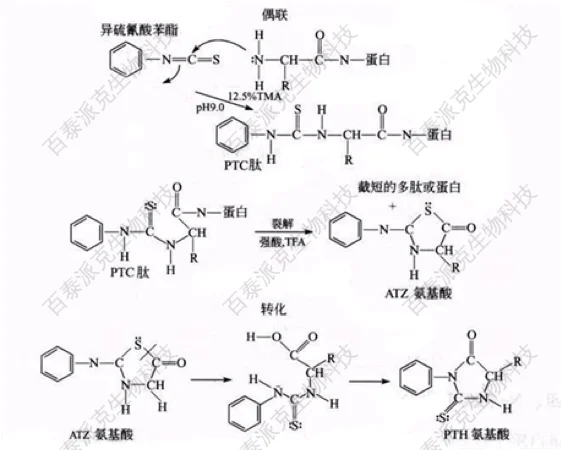
Chemical Principle of Edman Degradation
Basic Operating Steps of Edman Sequencer
1. First, open the high-purity argon valve to set the partial pressure to 0.5mp, then sequentially turn on the pump, detector, and sequencer host switches. After the detector completes automatic detection, turn on the computer.
2. Open the computer software to the main menu control interface. Prepare for sequencing according to the operating guidelines, such as preparing and loading various reagents and PTH-amino acids, preparing the HPLC system eluent, and ensuring that each reagent and eluent can complete the sequencing smoothly.
3. Pre-treatment in front of the sample sequencer reaction chamber: Place a new glass fiber filter membrane on top of the glass block of the reaction chamber, add Biobrene, dry it, and perform pre-circulation. Add the protein sample onto the pre-circulated glass fiber membrane, dry the sample, and then cover it with a microporous PTFE (teflon) filter membrane. Invert the upper and lower glass columns and fix them in the reaction jacket.
4. Program the sequencing procedure on the computer, such as sample name, choosing the cycling method, setting the number of cycles, standard amino acids, and sample injection volume.
5. Adjust the HPLC system to an optimized state, perform a standard amino acid cycle in advance, and check if all PTH-amino acids achieve baseline separation.
6. Turn off the machine after sequencing is complete.
7. Analyze the HPLC chromatogram data and compare it with the standard HPLC chromatogram for amino acid identification.
Principle of Edman Sequencing for PTH-Amino Acids
In each sequencing cycle, the Edman sequencer first separates the PTH-amino acids, then uses HPLC to determine the PTH-amino acid chromatograms, and compares them with the standard HPLC chromatograms of 20 amino acids to obtain the corresponding amino acid information. The diagram below shows the standard HPLC chromatograms of 20 amino acids.
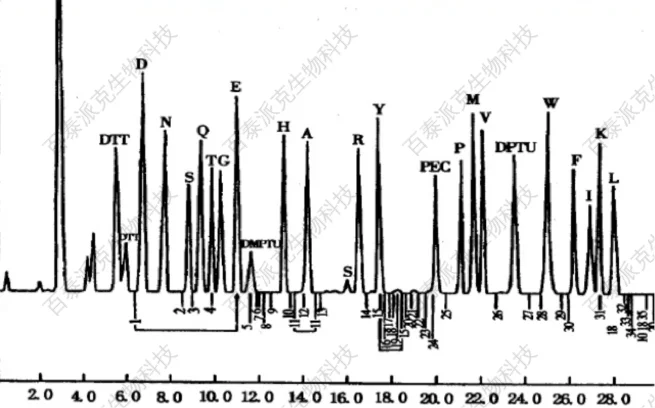
Edman Sequencer Standard PTH-Amino Acid HPLC Chromatogram
Protein N-terminal Blocking Case
Edman degradation is the gold standard for testing the N-terminal sequence of existing protein samples and is widely used. However, there are limitations in practical applications. For example, a client sent a sample for N-terminal sequencing of a recombinant protein expressed in Bacillus. However, after transferring the sample to a PVDF membrane, there was no signal during sequencing, even after repetition. Based on experience, it was suspected that the recombinant protein might have undergone N-terminal blocking.
What is Protein N-terminal Blocking?
In an unblocked state, the protein's N-terminus has a free alpha-amino group, and PITC reacts with it in the first step of Edman degradation sequencing. When the N-terminus is blocked, the alpha-amino group is modified, lacking a free alpha-amino, preventing PITC from binding, thus halting the Edman degradation reaction. Naturally, 50% of proteins have modified N-termini, commonly through acetylation, methylation, or pyroglutamylation. N-terminal blocking can also occur during protein sample purification due to detergents or chemicals reacting with functional groups or high pH solvents causing modifications.
Since Edman degradation cannot sequence proteins with N-terminal blocking, proteolytic digestion into peptides followed by liquid chromatography-mass spectrometry (LC-MS) can be used for sequencing. If the blocking modification is known, specific proteases can remove the N-terminal modification, allowing Edman degradation sequencing. For example, many antibody drugs have pyroglutamate cyclization blocking at the N-terminus, which can be sequenced using Edman degradation after enzymatic digestion with pyroglutamyl peptidase.
Factors Affecting Edman Degradation Results
1. Impurities in sequencing reagents can produce false peaks in the PTH chromatogram, affecting accurate amino acid sequence determination.
2. Different chemical or physical properties of amino acid residues can affect PTH signal intensity, altering peak values. Tyrosine and serine can dehydroxylate, altering peaks; cysteine modifications can hinder signal detection; histidine and arginine extraction is difficult due to polarity; methionine is easily oxidized, lowering peak values.
3. Modified residues showing peaks similar to unmodified amino acids during detection can cause amino acid identification errors.
How to order?




