






Electrospray Ionization
Electrospray ionization (ESI) is a technique that uses electrospray to apply high voltage to a liquid to produce aerosols, thereby generating ions for mass spectrometry analysis. Because biological macromolecules are relatively fragile, their structures can be easily disrupted during dissociation and ionization processes. Electrospray ionization overcomes the tendency of these molecules to fragment during ionization. Unlike other atmospheric pressure ionization processes, electrospray ionization can produce multiply charged ions, effectively extending the mass range of the analyzer to accommodate the sizes of proteins and their related peptides observed in the kDa-mDa range.
Principle of Electrospray Ionization
ESI applies a high voltage at the outlet of a capillary, and the resulting high electric field atomizes the liquid flowing out of the capillary into tiny charged droplets. As the solvent evaporates, the charge intensity on the droplet surface gradually increases, and finally, the droplet splits into one or more charged ions, allowing the analyte to enter the gas phase as singly or multiply charged ions.
There are two explanations for the mechanism of gas-phase ion generation: the Ion Evaporation Model (IEM) proposed by Thomson and Iribarne, and the Charge Residue Model (CRM) proposed by Dole and Rllgen. In both models, the ions to be analyzed are not excited by external energy and do not fragment during the process of becoming gas-phase ions.
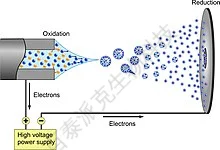
Mechanism of Electrospray Ionization
Process of Electrospray Ionization
The ESI process can be roughly divided into three stages: droplet formation, desolvation, and gas-phase ion formation.
1. Droplet Formation. Under the influence of a high electric field, the sample solution is sprayed from the capillary, forming charged droplets.
2. Desolvation. The droplets entering the spray chamber are evaporated in a countercurrent by heated drying gas (such as nitrogen), reducing the droplet diameter and increasing surface charge density. When the Rayleigh limit is reached, the Coulombic repulsion between charges is sufficient to overcome the surface tension of the droplet, causing it to fission and produce smaller charged droplets.
3. Gas-phase Ion Formation. When the charged droplets become nanometer-sized, the ions within the droplets transition into gas-phase ions.
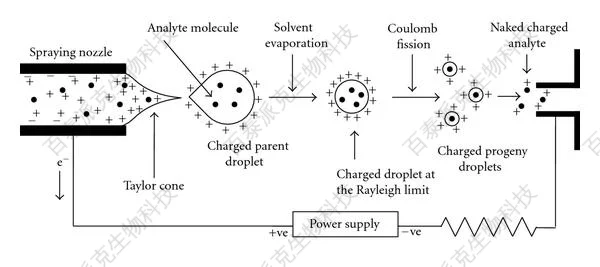
Electrospray Ionization Process
Advantages and Disadvantages of Electrospray Ionization
As a new type of soft ionization technology, ESI has been widely applied in many fields. Although this technology compensates for some of the shortcomings of traditional mass spectrometry technologies, it still has some limitations.
Advantages of ESI
1. Electrospray provides a relatively simple method for ionizing non-volatile solutions, enabling mass spectrometers to offer sensitive direct detection. Electrospray mass spectrometry can be used not only for the detection and analysis of inorganic substances but also for organometallic ion complexes and biomolecules.
2. In electrospray mass spectrometry, high molecular weight molecules typically carry multiple charges. The distribution of charge states can accurately quantify molecular weight, providing accurate molecular weight and structural information.
3. Multiple ionization modes are available: positive ion mode and negative ion mode.
4. Can be effectively combined with various chromatography techniques for complex system analysis.
Disadvantages of ESI
1. Experimental parameters or technical conditions must be carefully selected according to the problem to be solved.
2. The choice of solvents and the range of solutions that can be used are limited. Additionally, the mass spectrometer's response varies greatly for different complexes, hindering accurate quantitative analysis.
3. Since the spray process is controlled by solution parameters, ion signals may fluctuate even under optimal conditions.
Applications of ESI
ESI is a soft ionization technology that addresses the ionization of highly polar, thermally unstable proteins and the determination of molecular masses of large organic molecules. Compared with previous mass spectrometry technologies, ESI significantly improves the sensitivity, accuracy, and complexity of mixture analysis, broadening the application of mass spectrometry in the field of proteins.
Peptides and Proteins: ESI can introduce charge into protein solutions, then evaporate the solvent, and finally obtain charged peptides. ESI-MS has separation and identification capabilities and is commonly used to identify complex peptide mixtures, such as mixed protein digests or mixed protein bands on SDS-PAGE gels. ESI-MS is particularly suitable for tandem mass spectrometry because it can produce multiple charge peaks, and multiply charged ions are prone to fragmentation, increasing collision activation sensitivity. It is used to monitor target peptides and obtain complete sequence information.
Nucleotides: The emergence of ESI provides a powerful method for the structural and sequence analysis of oligonucleotides and their analogs. ESI partially degrades test samples of oligonucleotides and samples them at different times for mass spectrometry analysis to obtain molecular ion peak signals of partially degraded oligonucleotides. By comparing the molecular mass of two adjacent fragments, the molecular mass of the cleaved nucleotide monomer can be calculated, and the sequence of the oligonucleotide can be read by comparing it with the standard molecular masses of the four deoxynucleotides.
Molecular Mass of Ions: The characteristic of electrospray ionization is the production of highly charged ions rather than fragment ions, reducing the mass-to-charge ratio (m/z) to a range detectable by most mass spectrometers, thus greatly expanding the range of molecular mass analysis. The molecular mass of ions can also be calculated from the mass-to-charge ratio and charge number.
ESI is a soft ionization method that facilitates the widespread use of ESI sources in mass spectrometry. Even compounds with large molecular weights and poor stability do not decompose during the ionization process.
Related Services
Proteomics Services
Metabolomics Services
Glycomics Analysis Services
How to order?




