






Fourier Transform Infrared Spectroscopy (FTIR) Analysis
Fourier Transform Infrared Spectroscopy (FT IR) is a powerful technique used to obtain the absorption/emission infrared spectra of solids, liquids, or gases. When infrared radiation passes through the sample being tested, a portion of the infrared radiation is absorbed by specific covalent bonds of functional groups, while another portion directly penetrates. The collected spectrum represents the absorption and transmission of the molecules, forming a molecular fingerprint used for chemical identification. This also makes infrared spectroscopy applicable for various types of analyses. Fourier Transform Infrared Spectrometers simultaneously collect high-resolution spectra over a wide wavelength range, which is a significant advantage over dispersive spectrometers, which can only measure peak intensity over a relatively narrow wavelength range at one time.
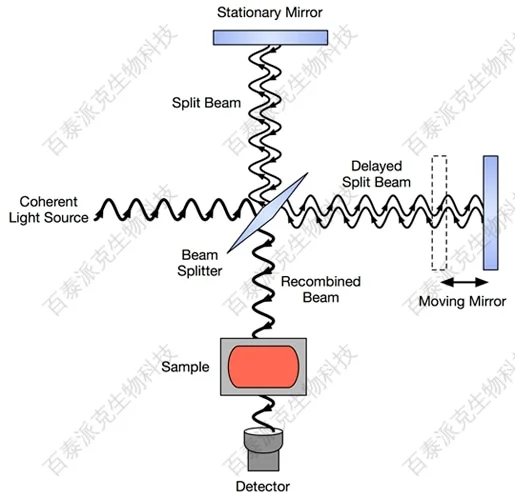
Fourier Transform Infrared Spectroscopy (FT IR) Analysis
Fourier Transform Infrared Spectrometers can outperform dispersive or filter methods used in infrared spectroscopy analysis in all applications that use dispersive instruments to enhance sensitivity and speed, due to: 1. Non-destructive nature; 2. No need for external calibration; 3. Faster speed; 4. Higher sensitivity; 5. Higher light throughput; 6. Simpler operation.
Applications of Fourier Transform Infrared Spectrometer Analysis
1. Chemical identification based on spectral differences of homogeneity, homologues, geometric and optical isomers;
2. Identification of functional groups in the tested chemicals based on absorbed wavelengths;
3. Estimation of purity by studying the peaks of potential contaminants;
4. Tracking chemical reaction processes by comparing peaks of specific functional groups;
5. Quantitative analysis of chemical substances by monitoring specific peaks.
How to order?




