






Detection Methods of Disulfide Bonds and Their Significance in Protein Function Research
Disulfide bonds are an important type of chemical bond in proteins, crucial for the structure and function of proteins. However, due to their unique properties, detecting disulfide bonds has always been a challenge in protein research. With the advancement of technology, various detection methods have emerged, providing important means for us to gain a deeper understanding of protein structure and function.
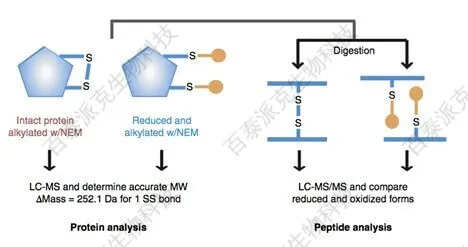
Figure 1
1.Characteristics of Disulfide Bonds
Disulfide bonds are covalent bonds formed between two sulfur atoms, having a significant impact on the stability and structure of proteins. The formation and cleavage of disulfide bonds are key driving forces in protein folding and conformational changes. Additionally, disulfide bonds can also participate in the regulation of protein activity and signal transduction processes.
2.Traditional Method: Ellman's Reagent Method
Ellman's reagent method is a traditional method for detecting disulfide bonds by quantitatively analyzing the thiolate ions released from sulfur atoms in disulfide bonds. This method is simple and intuitive, suitable for both in vitro and in vivo samples. However, Ellman's reagent method has certain limitations for complex samples and low concentrations of disulfide bond detection.
3.Mass Spectrometry: Mass Spectrometry Coupling Techniques
Mass spectrometry coupling techniques (MS) play an important role in the detection of disulfide bonds. By coupling mass spectrometry with chromatography and other separation techniques, it is possible to identify and quantitatively analyze disulfide bonds in protein samples. Mass spectrometry offers the advantages of high sensitivity, high resolution, and high accuracy, making it applicable for complex samples and low concentrations of disulfide bond detection.
4.Molecular Probe Method: Thiol-Conjugate Probe
The thiol-conjugate probe is a method for detecting disulfide bonds based on molecular probes. This method utilizes the reaction characteristics of thioether bonds, generating a fluorescence signal through the reaction of the thiol-conjugate probe with disulfide bonds to achieve quantitative analysis. This method has advantages for detecting disulfide bonds in vivo and can be applied in studies involving live cells and animal models.
5.Significance of Disulfide Bonds in Protein Function Research
Disulfide bonds hold significant importance in protein function research. By uncovering the mechanisms of formation, cleavage, and regulation of disulfide bonds, we can gain deeper insights into the processes of protein folding and conformational changes, as well as the regulation of protein functions. Furthermore, disulfide bonds are closely related to the occurrence of certain protein diseases and drug development, providing new perspectives and targets for the diagnosis and treatment of related diseases.
The methods for detecting disulfide bonds provide important tools and means for gaining a deeper understanding of protein structure and function. From traditional Ellman's reagent method to modern mass spectrometry coupling techniques and molecular probe methods, the continuous emergence of new technologies has advanced the progress of disulfide bond research. By revealing the characteristics and mechanisms of disulfide bonds, we can better understand the biological functions of proteins and provide new directions and strategies for related disease research and drug development.
Biotech PacBio--BiotechnologyProductsCharacterization, a leading service provider of multi-omics mass spectrometry detection
Related Services:
Identification and Quantitative Analysis of Protein Disulfide Bonds
Detection of Disulfide Bonds/Free Cysteine in Biopharmaceuticals
Protein Structure Identification
Determination of Protein Primary Structure
Protein Mass Spectrometry Identification
Post-Translational Modification Proteomics Analysis
How to order?




