






Exploration of Quantitative Analysis Strategies for Disulfide Bonds in Proteins
Disulfide bonds are an important type of chemical bond in proteins and are crucial for their structure and function. Quantitative analysis of disulfide bonds is a key step in understanding protein structure and function in depth. However, due to the unique nature of disulfide bonds, their quantitative analysis has been one of the challenges in the biopharmaceutical field. With technological advancements, different analytical strategies have been proposed and developed, providing important tools for exploring disulfide bonds in proteins.
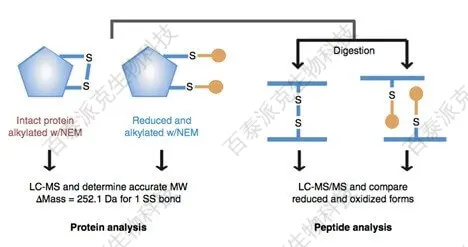
Figure 1
1.Significance of Disulfide Bonds
Disulfide bonds are covalent bonds formed between two sulfur atoms and have important implications for the stability and structure of proteins. The presence of disulfide bonds can maintain the three-dimensional structure and function of proteins and is involved in protein folding, stability, and activity regulation. Therefore, accurate quantitative analysis of disulfide bonds in proteins is of great significance for revealing their function and studying their biological roles.
2.Traditional Method: Ellman's Reagent
Ellman's reagent is a traditional method for the quantitative analysis of disulfide bonds, which measures the thiol ions released from sulfur atoms in disulfide bonds for quantitative analysis. This method is simple and straightforward, suitable for both in vitro and in vivo samples. However, Ellman's reagent has certain limitations in analyzing complex samples and low concentrations of disulfide bonds.
3.Mass Spectrometry: Mass Spectrometry Coupling Technology
Mass spectrometry coupling technology (MS) plays an important role in the quantitative analysis of disulfide bonds. By combining mass spectrometry with separation techniques such as chromatography, it is possible to identify and quantitatively analyze disulfide bonds in protein samples. Mass spectrometry offers advantages of high sensitivity, high resolution, and high accuracy, and can be applied to the analysis of complex samples and low concentrations of disulfide bonds.
4.Antibody Probe Method: Disulfide Bond-Specific Antibodies
Disulfide bond-specific antibodies are an immunology-based strategy for the quantitative analysis of disulfide bonds. This method uses specific antibodies to bind specifically with disulfide bonds and achieves quantitative analysis by detecting the complexes formed between the antibodies and disulfide bonds. Disulfide bond-specific antibodies have high selectivity and sensitivity and can be used to detect the content of disulfide bonds in complex samples.
5.Applications of Disulfide Bonds
Accurate quantitative analysis of disulfide bonds in proteins is of significant importance in many application fields. In the biopharmaceutical industry, disulfide bond analysis can be used for quality control and consistency evaluation of protein drugs. Additionally, abnormalities in disulfide bonds are related to the occurrence of some protein diseases and drug toxicity, so quantitative analysis of disulfide bonds aids in researching the mechanisms of related diseases and developing new drug treatment strategies.
Exploring quantitative analysis strategies for disulfide bonds in proteins is crucial for gaining an in-depth understanding of protein structure and function. Traditional methods like Ellman's reagent, mass spectrometry coupling technology, and antibody probe methods provide us with diverse options. By accurately quantitatively analyzing disulfide bonds in proteins, we can better understand their biological functions and provide strong support for drug development and quality control in the biopharmaceutical field.
Biotech Company Baiteipike--BiologicalProductsCharacterization, Multi-Omics Mass Spectrometry Detection Quality Service Provider
Related Services:
Protein Disulfide Bond Identification and Quantitative Analysis
Biopharmaceutical Disulfide Bond/Free Cysteine Detection
Protein Structure Identification
Determination of Protein Primary Structure
Protein Mass Spectrometry Identification
Post-Translational Modification Proteomics Analysis
How to order?




