






How to Measure the Extinction Coefficient?
The extinction coefficient is an important parameter in the field of biopharmaceutical analysis, used to measure the ability of a substance in solution to absorb light. Determining the extinction coefficient helps scientists understand information such as the concentration, purity, and reaction kinetics of the substance in solution. This article will introduce methods for measuring the extinction coefficient and its applications in the field of biopharmaceuticals.
1. Theoretical Basis
The extinction coefficient is defined as the ability of a substance to absorb light at a unit concentration. It is related to the molar absorptivity of the substance and the path length. Molar absorptivity indicates the ability of a substance to absorb light at a unit molar concentration, while the path length represents the distance light travels through the solution. The extinction coefficient can be calculated as the product of molar absorptivity and path length.
2. Measurement Methods
2.1 Spectrophotometry
Spectrophotometry is a common method for determining the extinction coefficient. It uses a spectrophotometer to measure the degree of absorption of different wavelengths of light by the solution and then calculates the extinction coefficient based on colorimetry or photometry. This method is suitable for substances with relatively complex absorption spectra, such as organic compounds and biological macromolecules.
2.2 Colorimetry
Colorimetry is a simple and commonly used method for determining the extinction coefficient. It utilizes the principle that the degree of absorption of specific wavelengths of light by a solution is proportional to the concentration of the substance in the solution. By comparing the relationship between absorbance and concentration, the extinction coefficient can be calculated. This method is suitable for substances with relatively simple absorption spectra, such as inorganic salts and certain small organic molecules.
2.3 Photometry
Photometry is a precise and sensitive method for determining the extinction coefficient. It uses the principle that the degree of absorption of specific wavelengths of light by a solution is proportional to the concentration of the substance in the solution. By comparing the relationship between light intensity and concentration, the extinction coefficient can be calculated. This method is suitable for substances with relatively complex absorption spectra, such as biological macromolecules and certain drugs.
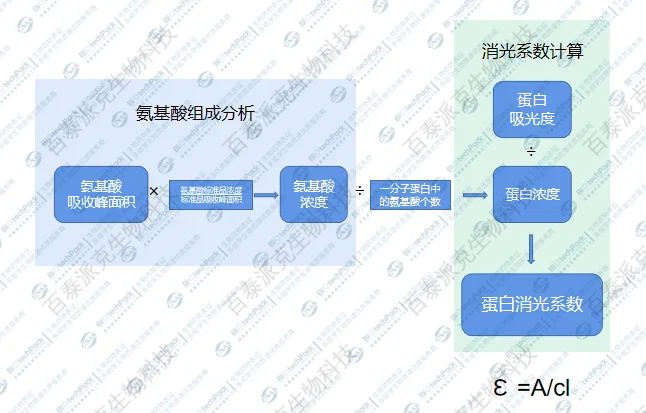
Figure 1
3. Applications
The determination of the extinction coefficient has wide applications in the biopharmaceutical field. Below are some common application areas:
3.1 Protein Concentration Determination
The extinction coefficient can be used to determine the concentration of proteins. By measuring the absorbance of a protein solution at a specific wavelength and using a known extinction coefficient, the concentration of the protein can be calculated. This is crucial for protein expression, purification, and quantification in the biopharmaceutical field.
3.2 Drug Analysis
The extinction coefficient can be used for drug analysis and quality control. By measuring the absorbance of a drug solution at a specific wavelength and using a known extinction coefficient, the concentration and purity of the drug can be calculated. This is significant for drug development, production, and quality monitoring.
3.3 Reaction Kinetics Research
The extinction coefficient can be used to study the kinetics of chemical reactions. By measuring the change in absorbance of a reaction solution at a specific wavelength over time, information such as reaction rates and mechanisms can be obtained. This is very helpful for reaction optimization and process improvement in the biopharmaceutical field.
4. Conclusion
The measurement of the extinction coefficient is one of the important techniques in the field of biopharmaceutical analysis. By selecting appropriate measurement methods, scientists can accurately measure the extinction coefficient of substances in solution, thereby obtaining information on concentration, purity, and reaction kinetics. The applications of the extinction coefficient are extensive, covering areas such as protein concentration determination, drug analysis, and reaction kinetics research. In future biopharmaceutical research, the measurement of the extinction coefficient will continue to play an important role.
Biotech Biopharmaceuticals - A Premium Service Provider of Biopharmaceutical Characterization and Multi-Omics Mass Spectrometry Detection
Related Services:
Extinction Coefficient Analysis
Other Process-Related Impurity Analysis
Product-Related Impurity Analysis
Protein Purity Analysis (Size Exclusion/Reverse Phase Chromatography)
How to order?




