






Principles, Advantages, and Disadvantages of Edman Degradation Sequencing
Principle of Edman Sequencing
Edman degradation sequencing, introduced and refined by Swedish chemist Pehr Edman in the 1950s, is a classical protein N-terminal sequence analysis technique. This method employs phenyl isothiocyanate (PITC) to selectively condense with the N-terminal α-amino group of a peptide chain under mildly alkaline conditions, forming a phenylthiocarbamyl (PTC) derivative soluble in organic solvents. Subsequently, under acidic conditions, the first residue of the derivatized peptide is cyclized and cleaved to generate an identifiable bicyclic derivative (ATZ-amino acid). By isomerization and separation via mass spectrometry or high-performance liquid chromatography, the chemical identity of the residue can be determined. This process is repeated, allowing researchers to sequentially 'peel the onion' and read the linear sequence of the polypeptide. Due to its strict dependence on free α-amino groups, Edman sequencing can achieve single-residue resolution on nanomole-scale samples, with a theoretical recovery rate of 98% per cycle. It is particularly suitable for locating the mature protein N-terminus, verifying whether post-translational modifications obscure the initial residue, and confirming the identity of target proteins in immunoblot bands or SDS-PAGE purified bands. For purified peptide segments or in-gel proteins ranging from 3 kDa to 30 kDa, and when precise N-terminal sequences are needed without database reliance, Edman degradation remains the irreplaceable 'gold standard.'
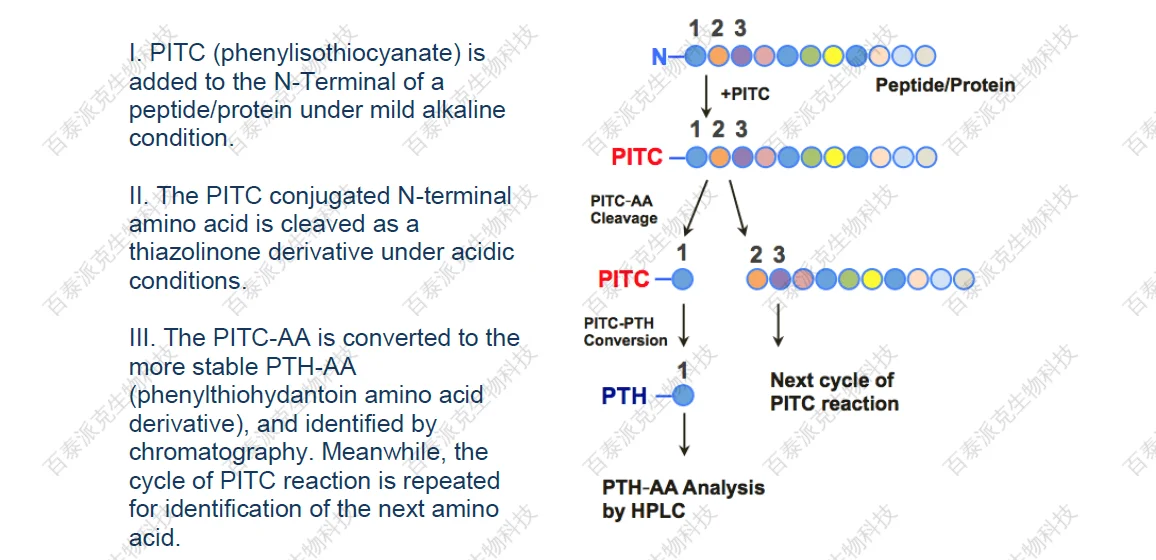
Figure 1. Edman Sequencing Process
Advantages of Edman Sequencing
The core of Edman degradation lies in its chemical specificity and cyclic efficiency. Phenyl isothiocyanate exhibits extremely high nucleophilic reactivity with free amino groups, while showing almost no affinity for side chains of the peptide, ensuring a unique reaction site. The solubility of PTC-peptide in polar organic solvents avoids diffusion barriers associated with solid-liquid phases. The ATZ-amino acids generated by acid cleavage possess a stable and UV-detectable conjugated system due to their bicyclic structure, ensuring each round of detection is both fast and sensitive. Through solid-phase fixation of samples (PVDF membranes or glass fiber filters) combined with fully automated cyclic reactors, modern instruments can identify 10–15 amino acid residues within 1–2 hours, greatly enhancing the response speed for high-throughput verification needs. In pharmaceutical research, Edman sequencing is often used to confirm the N-terminal sequences of antibody light or heavy chains, and to check for N-terminal truncation in recombinant protein drugs during upstream expression or downstream refinement processes. In disease mechanism research, cleavage sites of inflammation-related proteins or signal peptides can be precisely located using Edman, providing direct coordinates for designing targeted inhibitors.
Limitations of Edman Sequencing
However, Edman sequencing has inherent limitations. First, samples must have a free and unmodified (not post-translationally modified) N-terminal α-amino group; acetylation, formylation, or cyclization (e.g., pyroglutamate) will block the PITC condensation reaction, preventing the cycle from starting. Second, when there are multiple disulfide bonds, acid-unstable modifications, or rare amino acids (like selenocysteine), the acid cleavage step may induce side reactions, reducing sequencing accuracy; modified residues such as hydroxyproline lack stable derivatives, increasing identification difficulty. Additionally, due to approximately 1–2% derivation and cleavage loss per cycle, the theoretical maximum read length is typically limited to 40–60 residues, far less than the capacity of mass spectrometry sequencing to simultaneously resolve peptide segments of over a hundred residues. If the sample is a mixture or has N-terminal cleavage microheterogeneity, Edman is less able to resolve overlapping sequence signals in a single read. Furthermore, operations still rely on expensive reagents and specialized automated instruments, with maintenance costs and per-sample analysis expenses potentially exceeding those of traditional mass spectrometry in small to medium-scale experiments.
Solutions by Biotech Pack
To address these shortcomings, Biotech Pack integrates multiple strategies to inject modern vitality into Edman sequencing. First, in the sample preparation phase, selective deprotection and chemical reduction strategies are introduced: N-terminal deacetylase or hydroxylamine treatment can unmask α-amino groups under mild conditions, and DTT/TCEP is used to completely break disulfide bonds, fundamentally improving cycle initiation efficiency. For cyclized starting residues, acid or enzymatic ring-opening is used before derivatization. Second, the experimental platform is equipped with an ultra-micro laser cutting system and nanoscale trapping columns, enhancing transfer recovery rates from SDS-PAGE bands to solid-phase fixation by over 20% and significantly reducing background noise. For insoluble transmembrane fragments, the team employs a combination of hydrophobic trapping agents and reversible surfactants to maintain protein integrity while accommodating derivatization reaction throughput. Additionally, Biotech Pack overlays high-resolution LC-MS for auxiliary verification after cyclic detection: if the resolution of derivatized amino acid UV peaks is insufficient, mass spectrometry will double-confirm molecular weight and fragmentation fingerprints, minimizing residue misidentification. For requirements exceeding 50 residues, the company offers an 'Edman-MS combination strategy'—first, Edman accurately reads the initial 10–15 residues to determine the starting point, then high-energy CID/HCD segmented mass spectrometry covers the subsequent sequences, extending the overall read length to over 100 residues. Finally, on the data level, built-in algorithms automatically calibrate cycle efficiency decay curves, compensate for co-elution signals of isomeric amino acids, and output confidence scores, facilitating integration into LIMS or CMC files at the click of a button.
Conclusion
In summary, Edman degradation sequencing, as the earliest automated chemical technique for protein N-terminal analysis, still holds an irreplaceable position in modern proteomics and biopharmaceutical quality control. Its high chemical specificity, stable cyclic efficiency, and zero database dependency provide unique shortcuts for verifying unknown protein N-terminal sequences, locating truncations/cleavages, and assessing post-translational modification masking. Concurrently, it is limited by dependence on starting amino groups, limited read length, and stringent reaction conditions. With Biotech Pack's integration of enzymatic deprotection, nanoflow trapping, mass spectrometry coupling, and intelligent algorithms, the new generation Edman process has achieved breakthroughs in analysis throughput, accuracy, and read length, offering more flexible, reliable, and economical sequence verification services for basic researchers and biopharmaceutical developers. With this upgraded solution, researchers can rapidly obtain starting sequences from single bands at low nanomolar levels and perform segment validation on complex fusion proteins or transmembrane fragments, further shortening development cycles and enhancing the depth of structural and functional studies.
If you wish to learn more about Biotech Pack's Edman sequencing method, please contact our technical team for a customized quote. We look forward to working with you to accelerate breakthroughs in research and drug development.
Biotech Pack Biotechnology—Quality Service Provider for Bioproduct Characterization and Multi-Omics Mass Spectrometry Detection
Related Services:
How to order?




