






How does PRM proteomics assist in biomarker validation research?
Biomarkers, as crucial tools for early disease diagnosis, prognosis evaluation, and therapeutic monitoring, are becoming a hot topic in biomedical research. How can clinically significant biomarkers be screened and validated from thousands of proteins? Parallel Reaction Monitoring (PRM), a highly specific and high-throughput targeted protein quantification technique, has become a key method to advance biomarker research from 'candidate discovery' to 'mechanism validation' and 'clinical application.' This article systematically elucidates the application mechanism, technical advantages, experimental design, and analysis workflow of PRM proteomics in biomarker validation, dissecting its unique value in proteomics research to assist researchers in efficiently completing biomarker validation tasks.
I. From Discovery to Validation: Biomarker Validation Pathway
Biomarker research generally includes the following three stages:
1. Discovery Stage
Using non-targeted proteomics techniques such as Data Dependent Acquisition (DDA) or Data Independent Acquisition (DIA), differential expression protein candidates are screened from samples of different groups.
2. Verification Stage
Employing targeted technologies like PRM for high-precision, quantitative validation of candidate proteins in larger sample sizes.
3. Clinical Validation Stage
Using high-throughput platforms like ELISA and mass spectrometry peptide arrays to validate specificity and sensitivity in clinical cohorts.
PRM technology acts as a bridge between 'discovery' and 'clinical validation,' possessing strong targeting and sensitivity while maintaining the capacity for multiplex analysis, suitable for medium-scale validation tasks involving dozens to hundreds of candidate peptides.
II. PRM Technology Principles and Advantage Analysis
PRM is a targeted quantitative analysis method developed based on high-resolution, high-mass accuracy mass spectrometry platforms (such as the Thermo Orbitrap series). Its core principle is:
-
In MS1, target peptides are selected as precursor ions, which upon entering the fragmentation chamber generate multiple fragment ions.
-
In MS2, a full scan records all fragment ion signals.
-
Quantification and identification are achieved using the fragment ion spectrum characteristic of the peptide.
The main technical advantages of PRM proteomics include:
1. High Specificity
PRM simultaneously collects multiple high-resolution fragment ion peaks, effectively distinguishing co-eluting background signals, greatly enhancing detection selectivity, especially suitable for low-abundance proteins in complex samples (e.g., plasma, tissues).
2. High Accuracy and Reproducibility
Compared to SRM/MRM technology, PRM does not require predefined ion pairs, offering broader collection range and stronger adaptability, with experiment repeatability (CV) typically controlled within 10%.
3. Traceability and Strong Expandability
All collected MS2 spectra can be used for subsequent extraction of other peptide data, facilitating target expansion or error correction, making it an ideal tool for iterative studies and multicenter projects.
4. High Method Development Efficiency
Based on existing DDA/DIA data, target peptide lists can be constructed, and analysis methods quickly generated using software (e.g., Skyline), saving development time and labor costs.
III. Key Points in PRM Proteomics Experimental Design
Successful biomarker validation depends on reasonable PRM experimental design. Common design elements include:
1. Target Peptide Selection
(1) Peptides should uniquely map to the target protein, generally 7-20 amino acids in length
(2) Avoid modification-sensitive sites like oxidized residues (e.g., Met) or deamidation (e.g., Gln)
(3) Prefer peptides with good response intensity in DDA/DIA
2. Internal Standard Setup
(1) Stable isotope-labeled peptides are recommended as internal standards to achieve absolute quantification or improve relative quantification accuracy
(2) Internal standards should have retention times consistent with endogenous peptides, and similar ionization efficiency
3. Instrument Parameter Optimization
(1) Use high-resolution, high-mass accuracy Orbitrap instruments, with MS2 resolution suggested at 30,000 or higher
(2) Set reasonable retention time windows (RT window) and target fragment ion m/z to improve collection efficiency
4. Biological Replicates and QC Design
(1) At least 3 biological replicates are recommended for each sample group
(2) QC samples (e.g., mixed samples, stable isotope peptides) should be included to monitor system stability
IV. PRM Proteomics Data Analysis Workflow
1. Data Import and Target Setting
Import raw mass spectrometry data (e.g., Thermo .raw files) using software like Skyline, and load the list of target peptides and their corresponding fragment ions.
2. Chromatographic Peak Extraction and Identification
Extract ion chromatograms based on the set retention time windows and ion pair information, and identify chromatographic peaks automatically or manually.
3. Peak Integration and Quantification
Relative or absolute quantification of peptides is achieved by integrating the area values of various fragment ions, typically selecting 3-5 fragment ions with high signal-to-noise ratio and reproducibility.
4. Data Normalization and Standardization
Common methods include:
-
Normalization by internal standard (Normalization by SIS)
-
Total area normalization
-
Median normalization across runs
5. Statistical Analysis
Conduct statistical tests on processed quantitative data (such as t-test, Mann-Whitney U test), and evaluate diagnostic capabilities through ROC curves (AUC), sensitivity, and specificity.
6. Visualization and Report Output
Display differential peptide segment information through volcano plots, heat maps, cluster analysis, etc., and output standardized reports for project presentations or publications.
V. Comprehensive Advantages of PRM Proteomics Technology in Biomarker Validation
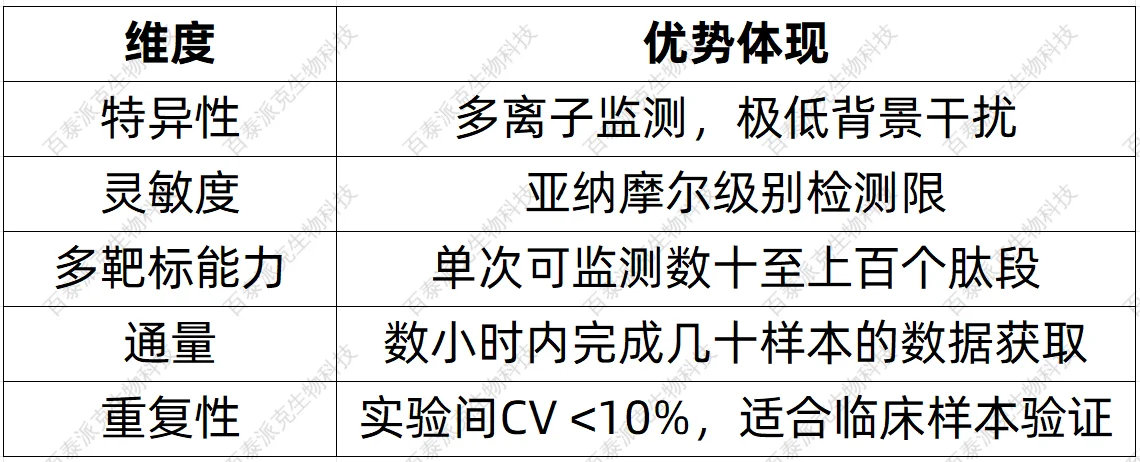
Biotech Co., Ltd. offers the following services based on the Orbitrap Fusion Lumos/Exploris platform, combined with a high-coverage target database and internally optimized PRM analysis workflow:
-
An integrated experimental scheme from DDA discovery to PRM validation
-
Self-built PRM template library covering tens of thousands of verified protein targets
-
Professional internal standard design and synthesis support for absolute quantification
-
Standardized analysis process (Skyline + R) outputs publication-grade charts and statistical results
-
Support for various sample types: serum/plasma, FFPE tissue, cell lysate, etc.
With its excellent specificity, sensitivity, and high reproducibility, PRM proteomics has become the 'gold standard' in the biomarker validation process. Through reasonable experimental design, precise internal standard control, and standardized data analysis, researchers can efficiently and reliably screen protein biomarkers with translational potential from numerous candidate molecules. Biotech Co., Ltd. will continue to optimize the PRM mass spectrometry platform and data processing workflows to assist biomarkers in transitioning from the laboratory to clinical settings, contributing technological strength to the development of precision medicine. If you have any technical needs during the biomarker validation process, please feel free to contact us for a free project evaluation and methodological advice.
Biotech Co., Ltd. — A premium service provider of bioproduct characterization and multi-omics mass spectrometry detection
Related Services:
How to order?




