






Comprehensive Guide to Common Issues and Solutions in SILAC Experiments
SILAC is widely used for cellular proteome quantification, protein interaction studies, and dynamic regulatory mechanism exploration due to its high accuracy, low batch error, and in situ labeling advantages. However, many researchers encounter issues such as low labeling efficiency, high mass spectrometry background, and data deviation from physiological state during actual operation, leading to experiment repetition, progress delay, or even data discard. This article, combined with experimental practice and mass spectrometry data experience, summarizes the most common issues in SILAC experiments and provides practical and actionable solutions to help you avoid risks and improve success rate.Experimental practice and mass spectrometry data experiencesummarizes the most common issues in SILAC experiments and providespractical and actionable solutionsto help you avoid risks and improve success rate.
Common Issue 1: Labeling efficiency below standard (<95%)
1. Problem Description
After culturing cells with heavy amino acids for several generations, a significant signal from 'light' peptides is still detected, with labeling efficiency below 95%, affecting subsequent quantification accuracy.
2. Solution
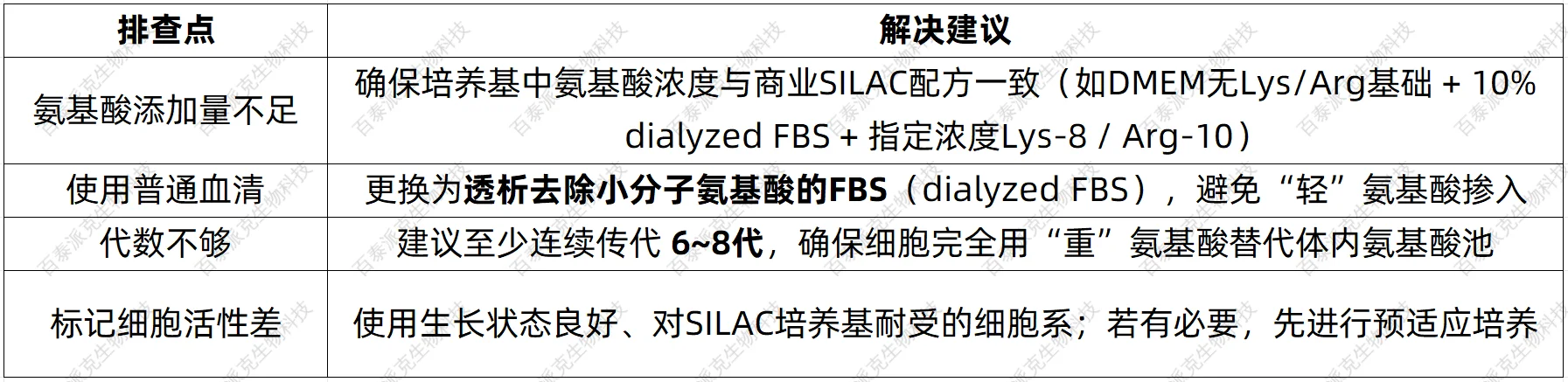
Biotech Pack Ltd.offers cell labeling efficiency verification service, monitoring light/heavy peptide ratio via LC-MS during pre-experiment, mid-experiment, and post-experiment stages to ensure data stability.
Common Issue 2: SILAC culture causing abnormal cell states
1. Problem Description
After switching to SILAC medium, cells exhibit slower proliferation, deteriorated state, and even detachment or death.
2. Solution
(1) Gradual adaptation: Transition cells from regular medium to 'mixed medium' (normal FBS + dialyzed FBS) for 1-2 generations;
(2)Nutritional supplementation: Add necessary nutrients in the early stage, such as non-essential amino acids (NEAA), glucose enhancement, etc.;
(3)Select appropriate cell lines: Some cells (such as certain neural cells, hematopoietic cells) are sensitive to nutritional changes; consider Super-SILAC strategy as an alternative;
(4)Avoid excessive passaging: Avoid excessive passaging (>10 generations) during labeling, as it may introduce transcriptome and proteome drift.
Common Issue 3: Sample processing causing isotopic 'cross-contamination'
1. Problem Description
When mixing light/heavy samples, 'cross-contamination' signals appear, with heavy peptide detected in light samples or vice versa.
2. Solution
(1) Separate lysis before mixing: Ensure to mix light/heavy samples after complete lysis to avoid cross-contamination at the cellular level;
(2)Fixed operating sequence: For example, process light samples first, then heavy samples; or use separate reagents and consumables to avoid cross-contamination;
(3)Use low-adsorption centrifuge tubes: Some peptides tend to adsorb to ordinary plastic tubes; choose mass spectrometry-grade low-adsorption consumables;
(4)Thorough cleaning: Ensure thorough removal of non-specific binding substances during immuno-enrichment or SDS cleaning process.
Common Issue 4: Poor mass spectrometry signal, high background, low reproducibility
1. Problem Description
After SILAC sample is loaded, protein coverage is low, differential protein fluctuation is large, and background interference is significant.
2. Solution
(1) Poor protein extraction cleanliness: Avoid using buffers containing SDS or denaturants; choose lysis buffers suitable for MS analysis;
(2)Low enzyme digestion efficiency: Optimize Trypsin:Lys-C combined enzyme digestion strategy; pre-purify peptides;
(3)Insufficient MS parameter optimization: Select high-resolution Orbitrap or timsTOF, enable SILAC mode quantification optimization;
(4)Sample mixing ratio deviation: Pre-determine protein concentration to ensure 1:1 equal mixing of light/heavy groups, otherwise quantification ratio may skew;
Biotech Pack Ltd.is equipped with automated protein quantification platform and standardized enzyme digestion process to ensure sample consistency and mass spectrometry signal quality.
Common Issue 5: Quantitative data deviating from true biological states
1. Problem Description
SILAC quantitative results are inconsistent with the trends observed in qPCR or WB, raising concerns.
2. Solutions
(1) Transcription/Translation Decoupling Phenomenon: Proteomics reflects post-translational state, not directly corresponding to mRNA levels;
(2)Differences in Stability: SILAC reflects 'steady-state protein levels', changes might not be apparent if the protein has a long half-life during short-term stress treatments;
(3)Inappropriate Time Point Selection: The optimal treatment time point should be determined through preliminary experiments;
(4)Labeling Disturbance to Cells: Long-term labeling may alter the baseline expression profile, it is recommended to include an unlabeled control group for background correction;
Biotech Pack BioTech provides one-stop SILAC technical support for you
As a professional proteomics solution provider, Biotech Pack BioTech offers:
-
Labeling efficiency assessment + cell culture support
-
Standardized protein extraction/digestion/peptide processing workflow
-
Quantitative mass spectrometry services with Orbitrap and timsTOF platforms
-
Differential protein screening + pathway enrichment analysis + visual report
-
Super-SILAC strategy customization, suitable for clinical sample research
Whether you are a SILAC beginner or working on advanced multi-channel designs, we can provide professional technical support and data delivery. SILAC is a highly mature and scientifically robust quantitative proteomics strategy, but it requires precise execution at every stage. Avoiding common mistakes not only saves a lot of trial-and-error costs but also significantly enhances the publication value and credibility of the data.
Biotech Pack BioTech - a premium service provider for bioproduct characterization and multi-omics mass spectrometry detection
Related Services:
Quantitative proteomics analysis based on SILAC/Dimethyl labeling
How to order?




