






Progress in the Application of Multiplexed SILAC Labeling in Tumor Proteomics
The occurrence and development of tumors is a complex multi-stage process involving mechanisms such as gene expression reprogramming, signal pathway imbalance, and microenvironment remodeling. Proteomics technology provides systematic tools to reveal these processes, buthow to achieve quantitative comparison of proteins in different statesremains one of the core challenges in tumor proteomics research. Against this backdrop, Multi-plexed SILAC technology has emerged. As an upgraded version of the SILAC strategy, it not only retains the advantages of high accuracy and low error but also allows simultaneous comparison of samples under three or more conditions. It is widely used in cancer subtype comparisons, drug action mechanism studies, and dynamic proteomics analysis in time series.
I. What is Multi-plexed SILAC labeling?
SILAC uses 'light/heavy' labeling to replace amino acids in two groups of cells, thereby distinguishing sample sources in mass spectrometry. Multi-plexed SILAC usually introduces 'medium weight' labels to achieveparallel quantitative analysis of three sample groups:

This strategy allows simultaneous comparison of multiple condition samples in a single mass spectrometry run, significantly improving experimental efficiency and reducing batch effects.
II. Applications of Multi-plexed SILAC labeling in tumor proteomics research
1. Comparison of protein expression profiles in tumor subtypes
Multi-plexed SILAC performs excellently in tumor subtype differential analysis. For example, researchers labeled HER2-positive, triple-negative, and Luminal A breast cancer cells as Heavy, Medium, and Light groups, respectively, and revealedsignificantly increased expression of proteins related to HER2 pathway activation(such as ERBB2, GRB7) while discovering severalpotential subtype-specific markersThis strategy avoids the systematic errors that arise from batch processing of three sample groups, making the results more comparable and reliable.
2. Analysis of drug action mechanisms and research on drug resistance mechanisms
In targeted therapy and drug resistance mechanism research, Multi-plexed SILAC can be used to dynamically track protein changes before and after drug treatment. For example, in EGFR inhibitor studies, untreated, short-term treated, and long-term drug-resistant lung cancer cells were labeled with three-channel SILAC, systematically identifyingearly response proteins and proteins related to later compensatory mechanismsproviding molecular clues for drug resistance mechanisms.
3. Dynamic proteomics and temporal change monitoring
Multi-plexed SILAC is also suitable fortime series research designFor example, observing protein expression changes at different time points (0h, 6h, 24h) under hypoxic stress in tumor cells can construct dynamic protein regulation models and reveal the stepwise response mechanism of the HIF pathway.
III. Super-SILAC: A New Breakthrough in Tissue Sample Research
SILAC is mostly used in cell culture systems, but in clinical tumor tissues, where in vivo labeling is not possible, the Super-SILAC strategy has emerged: Super-SILAC uses multiple SILAC-labeled cell lines mixed as a 'heavy labeled reference pool', which is mixed with non-labeled tumor tissue proteins and analyzed by mass spectrometry to achieveindirect quantitative comparison of tissue samplesThis strategy has been successfully used for:
-
large-scale quantitative proteomics of liver cancer tissues;
-
construction of personalized protein fingerprint profiles for lung cancer patients;
-
screening of protein targets related to predicting immune therapy responses.
The key to Super-SILAC lies inconstructing a cell line label library with strong representativeness and broad expression profile coverageThis is one of the decisive factors affecting data quality.
IV. Technical Advantages and Limitations of Multi-plexed SILAC Compared to TMT/iTRAQ
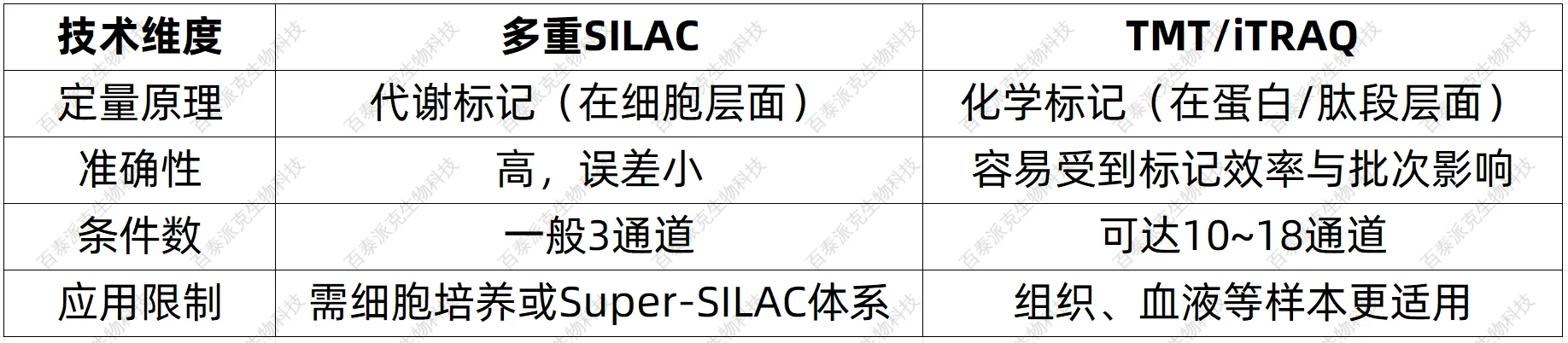
Although Multi-plexed SILAC has limited throughput, in tumor proteomics research, it is widely favored for itsstrong physiological relevance and good data consistencyFor high-throughput research on clinical samples, it is recommended to complement SILAC with TMT strategies.
Biotyper Biotech providescomprehensive solutions for Multi-plexed SILAC labelingand Super-SILAC experimental needs: optimization of labeled amino acids and cell line adaptation consulting; validation of high-throughput SILAC labeling efficiency and sample QC; combining Orbitrap Exploris 480 with proprietary analysis processes to achieve high sensitivity and low background protein quantification; providing Super-SILAC reference library construction and multi-sample tissue protein quantification services; visual report support for differential analysis, pathway enrichment, and marker screening. We have completed multi-omics collaborative projects for several university PIs and pharmaceutical clients, includinganalysis of breast cancer resistance mechanisms, characterization of liver cancer heterogeneity, and screening of lung cancer markersetc.
Multi-plexed SILAC labelingand its variant Super-SILAC are becoming indispensable tools in tumor proteomics research. Their high accuracy, good comparability between samples, and extensive expandability enable them to continue to play a role in mechanism analysis, clinical translation, and new target discovery. Biotyper Biotech will continue to deepen SILAC labeling and quantitative proteomics platforms, assisting more research teams in conducting precise and systematic tumor proteomics research.
Biotyper Biotech - A leading service provider in biopharmaceutical characterization and multi-omics mass spectrometry detection
Related services:
Quantitative proteomics analysis based on SILAC/Dimethyl labeling
How to order?




