






Parallel Reaction Monitoring (PRM): Principles, Workflow, and Applications
Parallel Reaction Monitoring (PRM) is a targeted quantitative proteomics technology based on high-resolution mass spectrometry. In recent years, it has been widely used in protein function research, biomarker validation, and targeted quantitative analysis in complex sample backgrounds. Compared to Multiple Reaction Monitoring (MRM), PRM offers significant advantages in specificity, resolution, and anti-interference capabilities, making it suitable for high-precision quantification of target peptides.
This article will provide a comprehensive analysis of PRM fromits underlying principles, experimental processes, technical advantages, and typical application scenariosacross four aspects, and introduce the technical features of Biotech Pack in PRM proteomics services.
I. Principles of Parallel Reaction Monitoring (PRM): Accurate identification of target peptides through 'multi-dimensional snapshots'
1. Core technology: Parallel acquisition of all product ions + high-resolution accurate mass detection
PRM, based on high-resolution, high-precision mass spectrometers (such as Orbitrap or Q-TOF), selectively fragments precursor ions of target peptides and collects all product ion signals in parallel. Unlike MRM, which depends on specific ion pairs (transitions), PRM can acquire a complete product ion spectrum in a single analysis, enhancing data specificity and reliability.
This 'full-spectrum acquisition' approach gives PRM stronger anti-interference capability in complex sample backgrounds, especially suitable for research scenarios with unpredictable ion interference.
2. PRM vs. MRM: Summary Comparison
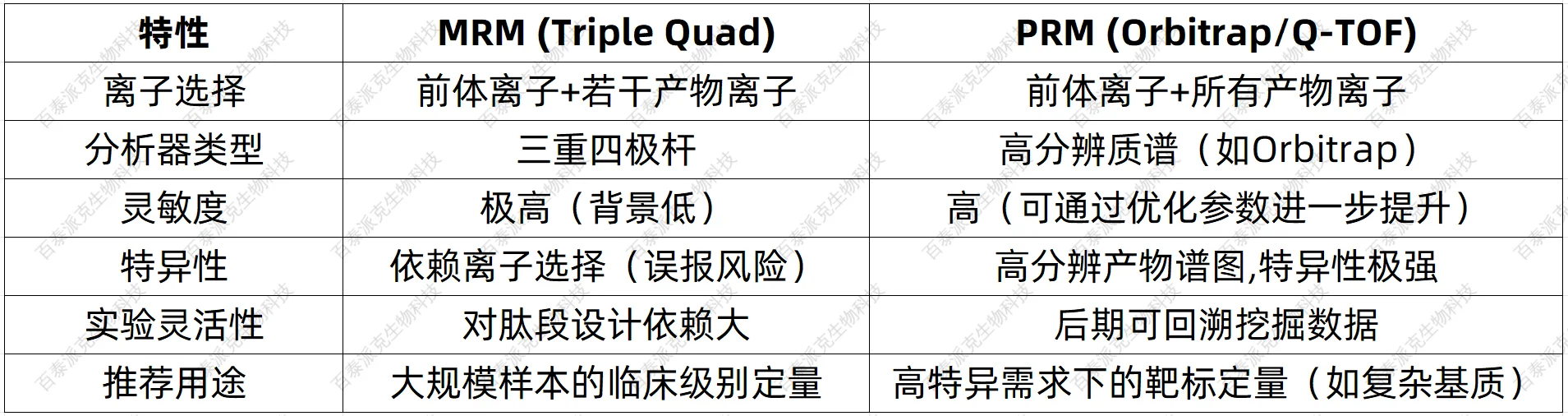
II. PRM Workflow: From Target Design to Quantitative Analysis
1. Target screening and peptide design
(1) Derived from DDA or DIA discovery phase, literature, or databases (such as PeptideAtlas, SRMAtlas)
(2) Selection criteria include:
-
Uniqueness (representative peptides)
-
Good ionization efficiency
-
Peptides that easily fragment to produce stable product ions
2. Standard choice (optional)
(1) Stable isotope-labeled peptides (SIS) can be added for absolute quantification
(2) Internal standard peptides for correcting sample processing and mass spectrometry drift errors
3、Sample processing
Typically involves: Protein extraction → Trypsin digestion → Purification → Add internal standard → Instrument analysis
4、Mass spectrometry analysis (Orbitrap PRM)
(1) Use high-resolution mass spectrometers (such as Thermo Orbitrap Exploris)
(2) Set precursor m/z of target peptides, automatically acquire full product ion spectrum
(3) Obtain high-resolution, high-specificity chromatographic peak maps
5、Data processing
(1) Mainly use Skyline software
(2) Validate and quantify through retention time, peak shape, and consistency of multiple product ions
(3) Can output relative quantification/absolute quantification results
III. Technical Advantages of PRM
1. High specificity
-
Based on complete product spectra + high resolution, greatly reduces false positive rates
-
Suitable for detecting low-abundance proteins or quantifying in high-background complex matrices (such as plasma, urine)
2. High flexibility
Only need to set target precursor ions, all fragment ion information is retained, facilitating subsequent exploration and method optimization
3. No need to develop Transition lists
Compared to MRM, PRM does not require cumbersome ion selection processes, shortening method development cycles
4. Complementary with DIA
PRM is suitable for validation experiments, while DIA is suitable for discovery. Used together, they form an efficient validation loop.
IV. Typical Application Scenarios of PRM
1. Biomarker validation
PRM is commonly used for validation after DDA or DIA screening, suitable for secondary quantitative confirmation of proteins with significant expression differences.
2. Target quantitative analysis in complex samples
In complex biological samples such as plasma, urine, cerebrospinal fluid, PRM can provide higher specificity, improving data quality.
3. Pharmacodynamics and time curve research
Used to evaluate the dynamic expression of key pathway proteins before and after drug treatment.
4. Quantitative regulation in synthetic biology
Precisely quantifying the expression levels of key enzymes in metabolic pathways to assist in regulatory strategy design.
Biotech Pack: Advantages of PRM Quantitative Proteomics Services
Biotech Pack has the following advantages in PRM platform construction and technical services:
-
High-resolution PRM platform: Equipped with Thermo Orbitrap Exploris 480 mass spectrometry system
-
Standardized process control: Sample processing - peptide screening - internal standard introduction - data analysis, all steps standardized
-
Supports internal standard absolute quantification: Synthesized stable isotope peptides, suitable for clinical validation needs
-
Integratable with DIA data: Providing a one-stop solution for your 'discovery → validation → translation' needs
Parallel Reaction Monitoring (PRM) is a targeted quantification strategy that leverages the advantages of high-resolution mass spectrometry, offering high sensitivity, high specificity, and high stability, particularly suitable fortarget protein validationandlow-abundance protein quantification. Its value in biomarker validation, clinical research, and complex sample analysis continues to emerge. By rationally designing targets, optimizing method development processes, and leveraging high-performance platforms, researchers can achieve protein quantification goals more reliably and accurately. Biotyper Bioinformatics is dedicated to providing you with high-quality, reliable PRM quantification solutions, assisting in the steady advancement of precision research and translational applications.
BaiTaiPike Biotech - Characterization of Biologics, Premium Service Provider for Multi-Omics Mass Spectrometry Detection
Related services:
How to order?




