






Protein Interaction Analysis
Protein interaction analysis involves analyzing the interactions between proteins. Once the interaction analysis is completed, techniques such as mass spectrometry are often used to identify interacting proteins. BGI Tech Solutions providesprotein interaction analysisand subsequentmass spectrometry identificationservices.
Protein interaction refers to the process where two or more protein molecules bind to form a protein complex. Typically, proteins function in coordination with multiple protein molecules to achieve complex cellular functions. Therefore, studying protein interactions is beneficial for exploring cellular functions in organisms, understanding the occurrence and development of diseases, finding specific disease prediction and treatment methods, and providing new ideas for new drug development. There are various methods for protein interaction analysis. Here, we briefly introduce protein interaction analysis using co-immunoprecipitation (CO-IP) combined with mass spectrometry, GST fusion protein pull-down technology combined with mass spectrometry, and SILAC combined with co-immunoprecipitation and mass spectrometry.
Protein interaction analysis using co-immunoprecipitation (CO-IP) combined with mass spectrometry
Co-immunoprecipitation (CO-IP) is a method that uses the specificity between antigens and antibodies to detect physiological interactions between proteins. In the experiment, non-ionic detergents are used to lyse cells, preserving protein interactions within the cells. Appropriate antibodies are added to bind with specific proteins in the cells, followed by the addition of protein A/G to form antibody-protein complexes. These complexes are then centrifuged and separated, precipitating the antibody-protein complexes, and the supernatant is discarded. Finally, mass spectrometry is used to identify the precipitated proteins, thereby demonstrating the interaction between them.
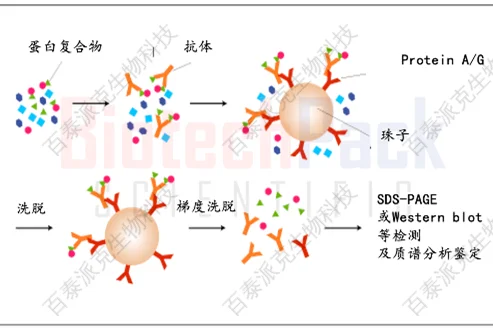
protein interaction analysis
Protein interaction analysis using GST fusion protein pull-down technology combined with mass spectrometry
The GST fusion protein pull-down assay involves inserting a GST tag into the target protein via genetic recombination. Glutathione-coated beads bind to the target fusion protein, and upon the addition of cell lysate, interacting proteins are adsorbed by the fusion protein. Excess glutathione is added for elution, and MS technology is used for analysis.
Protein interaction analysis using SILAC combined with co-immunoprecipitation and mass spectrometry
Using the SILAC method, cells in the experimental and control groups are labeled separately before conducting the Co-IP experiment. Immune complexes are isolated based on the specific reaction between antigen and antibody. These complexes are then qualitatively and quantitatively detected using LC-MS/MS. When the amount of a specific protein in the experimental group reaches a statistically significant difference compared to the control group, it is determined that this protein interacts with the protein under study, significantly reducing the possibility of false-positive results in protein interaction analysis.
related services
protein interaction analysis
protein mass spectrometry identification
CO-IP co-immunoprecipitation method for protein interaction analysis
GST pull-down protein interaction analysis
Protein interaction analysis using SILAC combined with co-immunoprecipitation and mass spectrometry
How to order?




