






Orbitrap or FT-ICR? A Comprehensive Analysis of Top-Down Mass Spectrometry Platforms
Top-Down mass spectrometry has gradually become an indispensable tool in proteomics, structural biology, and post-translational modification research due to its ability to directly analyze intact proteins. Choosing the right mass spectrometry platform is crucial in the face of complex protein subtypes, modification polymorphisms, and high precision demands. Orbitrap and FT-ICR are the two main high-resolution analysis platforms currently, each with its technical advantages and significant differences in applicable scenarios. This article focuses on the performance, core parameters, and application recommendations of these two platforms in Top-Down mass spectrometry, helping researchers make informed decisions.
1. Core Technical Requirements of Top-Down Mass Spectrometry
The Top-Down method directly ionizes, separates, and fragments intact protein molecules, requiring the mass spectrometry platform to exhibit excellent performance across multiple dimensions:
-
Resolution and mass accuracy: Needed to distinguish protein modification forms or sequence isomers with similar masses;
-
Ion fragmentation efficiency: Determines the ability to resolve the primary structure of proteins;
-
Dynamic range and sensitivity: Supports the detection of low-abundance proteins in complex biological samples;
-
Scan speed and stability: Meets the demands of high-throughput data acquisition.
Both Orbitrap and FT-ICR can cover these technical indicators, but they differ significantly in terms of resolution, operational efficiency, and equipment complexity.
2. FT-ICR: Ultra-high resolution molecular recognition capability
FT-ICR achieves mass analysis based on the cyclotron motion frequency of ions in an ultra-strong magnetic field, boasting the highest resolution among current mass spectrometry platforms, suitable for research scenarios requiring precise resolution of complex isotope peaks, multiple post-translational modifications, or large molecule isomers.
※ Technical Features
-
Extreme resolution: Resolution can exceed 10⁶, suitable for precise resolution of peak-dense regions;
-
Mass error controlled at sub-ppm level: Facilitates accurate confirmation of protein modification positions;
-
Flexible ion accumulation time: Conducive to enhancing signal-to-noise ratio and detection capability for low-abundance proteins.
※ Application Limitations
-
Slower analysis rate, not conducive to high-throughput or online LC-MS applications;
-
High maintenance and operational requirements, with significant dependency on laboratory infrastructure;
-
High equipment cost, with considerable initial investment and operational maintenance.
3. Orbitrap: A balanced high-throughput solution
Orbitrap measures mass based on the axial oscillation frequency of ions in an electrostatic field, striking a good balance between resolution, scan speed, and operational convenience, making it one of the most widely used platforms in current Top-Down mass spectrometry.
※ Technical Features
-
Combines high resolution with fast scanning: Supports 10⁵–10⁶ resolution, suitable for coupling with LC-MS for online analysis;
-
Supports multiple fragmentation modes (HCD, ETD, etc.): Enhances sequence coverage and modification information resolution capability;
-
System stability and ease of operation: Facilitates rapid deployment and replication of standardized processes.
※ Performance Boundaries
-
Slightly inferior to FT-ICR in ultra-high resolution, peak overlap may occur in specific high-complexity regions;
-
Limited fragmentation efficiency for extremely high molecular weight proteins (>150 kDa), requiring optimized methods or labeling strategies.
4. Technical Parameter Comparison: Orbitrap vs. FT-ICR
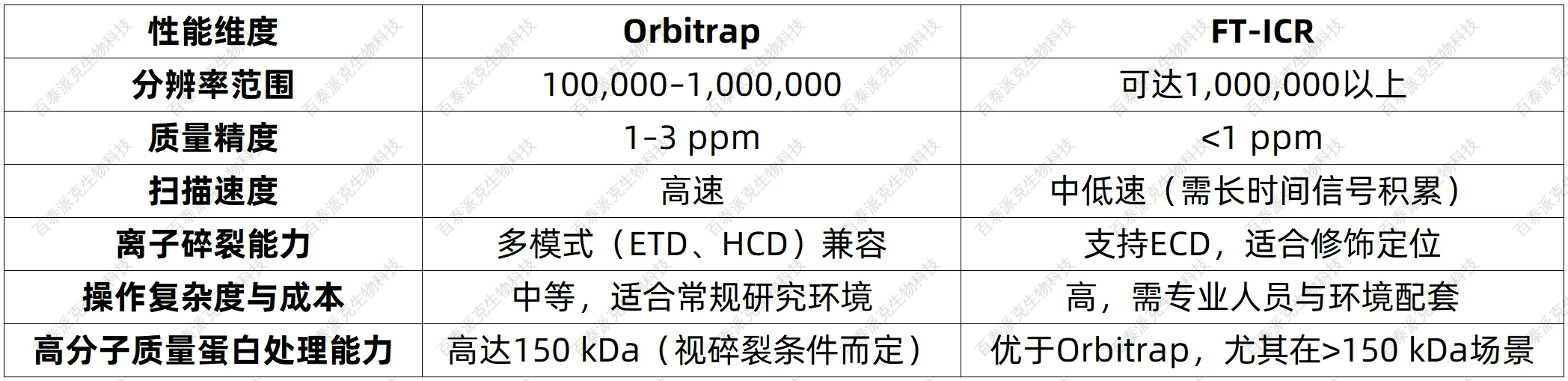
5. How to Choose the Most Suitable Top-Down Platform?
Selection of an analysis platform should be based on comprehensive considerations such as project requirements, sample characteristics, budget levels, and experiment throughput:
-
If the goal is high-fidelity structural resolution or recognition of complex modifications, FT-ICR is the ideal choice;
-
If focusing on throughput, process stability, and operational efficiency, Orbitrap offers better cost-effectiveness;
-
For large-scale sample analysis and routine protein subtype analysis, high-resolution Orbitrap is sufficient;
-
For extreme protein mass (>200 kDa) or multi-modification isomer analysis, FT-ICR should be prioritized.
Orbitrap and FT-ICR have their respective focuses in Top-Down mass spectrometry applications, forming a complementary rather than a substitutive relationship. The former excels in performance balance and application universality, while the latter has unparalleled advantages in extreme precision scenarios. Understanding their principle differences and technical boundaries helps researchers devise more targeted experimental strategies. Biotech Packard leverages advanced Orbitrap platforms to build a comprehensive technical system for Top-Down applications, offering services that include: protein subtype identification and quantification, joint localization of multiple post-translational modifications, high-quality molecular isomer resolution, direct analysis and structural inference of protein complexes, etc. We continue to support life science researchers in discovering more biological information value from the 'full picture' of proteins through professional platforms, reliable data, and efficient delivery.
Biotech Packard - A premium service provider for bioproduct characterization and multi-omics mass spectrometry detection
Related Services:
How to order?




