






De novo Sequencing Technology Revealed: Analyzing the Structure and Function of Unknown Peptides
De novo sequencing technology is a technique in bioinformatics primarily used to determine the amino acid sequence of new or unknown proteins or peptides. Unlike resequencing, this technology particularly focuses on proteins or peptides that have not yet been identified or are not present in existing databases.
1. Why is De novo sequencing needed?
Despite the existence of a large amount of known protein sequence data, there are still many protein and peptide sequences and functions that remain undiscovered. De novo sequencing can help researchers uncover the amino acid sequences of these unidentified proteins or peptides.
2. How is De novo sequencing conducted?
De novo sequencing primarily relies on mass spectrometry techniques, especially tandem mass spectrometry (MS/MS). In this technique, peptides are ionized and enter a mass spectrometer, where they are further fragmented into smaller pieces. The mass of these fragments is measured and used to deduce the original peptide's amino acid sequence.
3. Analyzing the structure and function of unknown peptides:
1. Structural analysis:
The amino acid sequence obtained through De novo sequencing can be used to predict the three-dimensional structure of proteins. Modern protein structure prediction algorithms, such as AlphaFold, can accurately predict the 3D structure of proteins based on their amino acid sequences.
2. Functional analysis:
Once the structure information of peptides or proteins is obtained, researchers can further conduct functional experiments such as binding assays and enzyme activity measurements to determine their biological functions. Additionally, by comparing them with known proteins or functional domains, their functions can also be inferred.
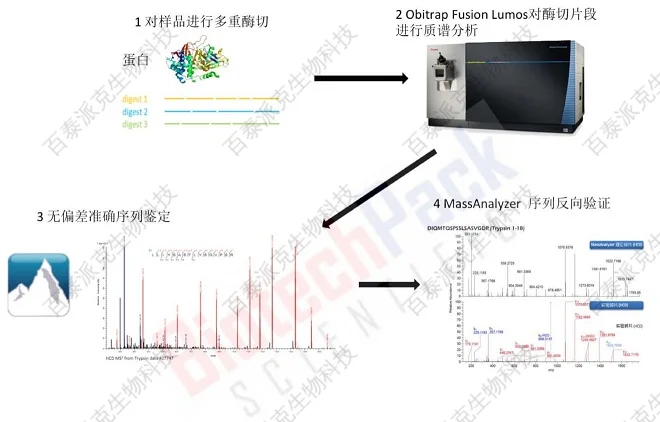
Figure 1
4. Challenges in De novo sequencing:
1. Complexity of fragment analysis:
Deducing the original peptide sequence from fragment masses is complex, and multiple possible sequences may exist.
2. Difficulty of sequencing long peptides:
Long peptides may generate a large number of fragments, making sequence deduction more challenging.
3. Large data volume:
De novo sequencing typically generates a large amount of data, requiring powerful computational capabilities and specialized software for analysis.
Bioinformatics and Proteomics Service Provider - High-quality services for biological product characterization and mass spectrometry detection of multiple groups.
Related services:
Protein de novo sequencing and mutation analysis
How to order?




