






How to Optimize Co-Immunoprecipitation (Co-IP) Technology for Protein Interaction Studies?
In biomedical research, understanding the network of protein-protein interactions is of great significance for uncovering cellular signaling, disease mechanisms, and the development of biopharmaceuticals. Immunoprecipitation (Co-IP) is a key method for studying protein interactions, helping scientists identify and analyze the relationships between proteins. However, due to sample complexity and experimental condition variations, this technique may face challenges in practical applications. Therefore, optimizing the Co-IP technique to improve its accuracy and sensitivity is crucial.
1. Basic Principle of Immunoprecipitation Technique
In the Co-IP technique, specific antibodies are used to bind and enrich target proteins and their interacting partners. First, antibodies are combined with solid phase carriers like magnetic beads or agarose to form an immunoaffinity column. This column is then used to enrich the target protein and its interaction partners, remove non-specific bindings, and finally, through washing and other steps, obtain high-purity target protein complexes. Subsequent protein separation and mass spectrometry analysis can identify and quantify proteins in the Co-IP samples, revealing protein interaction networks.
2. Key Steps in Optimizing Co-IP Technique
a. Selection of Suitable Antibodies
The choice of antibodies is crucial for the success of the Co-IP technique. Ensuring the use of highly specific and high-affinity antibodies can effectively enrich target proteins and their interacting partners. Researchers can determine the most suitable antibodies through literature review and preliminary experiments.
b. Optimization of Cell Lysis Conditions
Cell lysis is an important step to release proteins from cells. Optimizing cell lysis conditions can maximize the retention of the natural structure and interactions of proteins. Avoiding protein degradation and non-specific binding is vital for the accuracy of the Co-IP technique.
c. Consideration of Experimental Consistency
Ensuring consistency in experimental conditions is crucial for the reliability of results when conducting Co-IP experiments with multiple samples. Using the same batch of antibodies, identical cell culture conditions, and the same lysis conditions can reduce experimental variability.
d. Addition of Appropriate Negative Controls
In Co-IP experiments, adding negative controls helps distinguish between specific and non-specific binding. Negative controls can involve using magnetic beads or agarose not conjugated with antibodies to detect non-specific protein binding.
e. Validation with Other Techniques
To ensure the reliability of Co-IP experimental results, other techniques can be used for validation, such as mass spectrometry analysis and Western blotting. Cross-validation using multiple methods can more accurately identify and confirm protein interactions.
3. Applications and Prospects of Co-IP Technique
The Co-IP technique is widely applied in the study of protein interactions. Its importance in the biopharmaceutical field is increasingly evident, aiding in the discovery of new drug targets, revealing molecular mechanisms of diseases, and optimizing drug efficacy. With continuous technological development and improvement, the Co-IP technique will continue to play an important role in biomedical research.
Immunoprecipitation is an important method for studying protein interactions and has broad application prospects in the biopharmaceutical field. By optimizing the key steps of the Co-IP technique, we can enhance its accuracy and sensitivity, providing more reliable experimental results for protein interaction studies. With ongoing technological advancements, immunoprecipitation will continue to contribute to uncovering the mysteries of life and advancing the field of biopharmaceuticals.
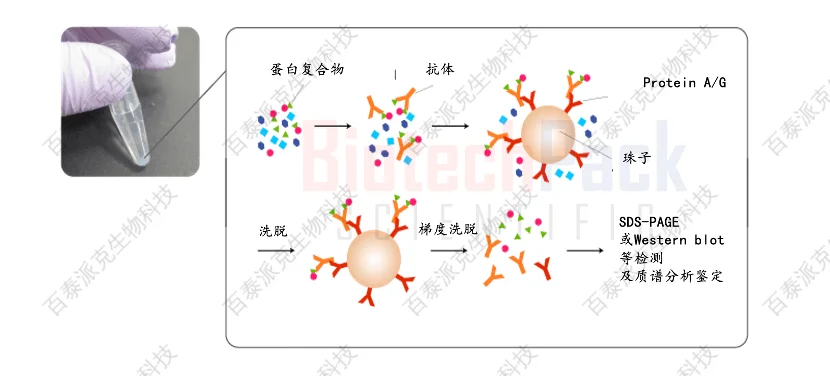
Figure 1
Biotech-Peak Biotech--BiotechnologyProductsCharacterization, Multi-omics Mass Spectrometry Detection Quality Service Provider
Related Services:
CO-IP Immunoprecipitation Method for Protein Interaction Analysis
Protein Interaction Analysis
Protein Interaction Mass Spectrometry Analysis
SILAC Combined with Immunoprecipitation Mass Spectrometry for Protein Interaction Analysis
Cross-linking Method for Protein Interaction Analysis
Far-Western Blot Analysis
Label Transfer Method for Protein Interaction Analysis
Pull-down Target Protein Mass Spectrometry Identification
How to order?




