






Comprehensive Comparison of Peptide Purity Detection Methods: Mass Spectrometry vs IP Sample Spectrum
1. Introduction
As an important component of biopharmaceuticals, the purity of peptides has a significant impact on the quality and efficacy of the drugs. Therefore, accurately and quickly detecting peptide purity has become one of the key issues in the field of biopharmaceutical research. Currently, the commonly used methods for peptide purity detection mainly include mass spectrometry and IP sample spectrum. This article will provide a comprehensive comparison of these two methods to help readers better understand the principles and applications of peptide purity detection.
2. Mass Spectrometry Method
Mass spectrometry is a method based on the measurement principle of the mass-to-charge ratio of peptide molecules, determining their purity by measuring the mass spectrum of peptide molecules. The mass spectrometry method has the advantages of high sensitivity, high resolution, and high accuracy, enabling comprehensive analysis and identification of peptide samples.
3. Principles of Mass Spectrometry
The mass spectrometry method is mainly based on two principles: mass analysis and fragmentation analysis. Mass analysis determines the molecular weight of peptide molecules by measuring their mass-to-charge ratio (m/z), thereby inferring their purity. Fragmentation analysis dissociates peptide samples to generate a series of fragment ions, and by measuring the mass spectrum of these fragment ions, the sequence and structure of the peptide can be determined.
4. Advantages of Mass Spectrometry Method
The mass spectrometry method has the following advantages:
-
High Sensitivity:The mass spectrometry method can detect peptides at extremely low concentrations, making it highly effective for samples with high purity requirements.
-
High Resolution:The mass spectrometry method can distinguish mass differences between different molecules in peptide samples, allowing for accurate purity assessment.
-
High Accuracy:By measuring the mass spectrum of peptide molecules, the mass spectrometry method can accurately determine the molecular weight and sequence of peptides.
5. IP Sample Spectrum Method
The IP sample spectrum is a method based on measuring the absorption spectrum of peptide samples under specific conditions. By measuring the absorbance of peptide samples at different wavelengths, their purity can be determined. The IP sample spectrum method is characterized by simplicity and speed, suitable for rapid screening of large-scale samples.
6. Principles of IP Sample Spectrum
The IP sample spectrum method is mainly based on the absorption characteristics of peptide samples in the UV-visible spectrum range. Peptide samples absorb specific light at certain wavelengths, and by measuring the absorbance at different wavelengths, the absorption spectrum of the peptide sample can be obtained to determine its purity.
7. Advantages of IP Sample Spectrum Method
The IP sample spectrum method has the following advantages:
-
Simple and Fast:The IP sample spectrum method does not require complex instruments and equipment, only a UV-visible spectrophotometer is needed for measurement, making it simple and quick to operate.
-
Wide Applicability:The IP sample spectrum method is applicable to various types of peptide samples, whether linear or cyclic, and can effectively detect them.
-
Non-destructive:The IP sample spectrum method does not require any treatment of the samples, thus not causing any damage and ensuring the integrity of the samples.
8. Comparison of Mass Spectrometry and IP Sample Spectrum Methods
Both mass spectrometry and IP sample spectrum methods are commonly used methods for peptide purity detection, each with its own advantages and disadvantages. Below is a comparison of the two methods.
8.1 Sensitivity
The sensitivity of the mass spectrometry method is higher than that of the IP sample spectrum method, capable of detecting lower concentrations of peptides. This is because the mass spectrometry method can accumulate signals through multiple scans, thereby enhancing detection sensitivity. In contrast, the IP sample spectrum method is limited by the detection limits of the absorption spectrum, resulting in relatively lower sensitivity.
8.2 Resolution
The resolution of the mass spectrometry method is higher than that of the IP sample spectrum method, capable of distinguishing mass differences between different molecules in peptide samples, thus accurately judging their purity. The IP sample spectrum method can only determine peptide purity based on the peak positions of the absorption spectrum and cannot distinguish mass differences between different molecules.
8.3 Accuracy
The accuracy of the mass spectrometry method is higher than that of the IP sample spectrum method. It can accurately determine the molecular weight and sequence of peptides by measuring the mass spectrum of peptide molecules. In contrast, the IP sample spectrum method can only judge peptide purity based on the peak positions of the absorption spectrum and cannot determine the molecular weight and sequence of peptides.
8.4 Applicability
The applicability of the mass spectrometry and IP sample spectrum methods differs. The mass spectrometry method is suitable for various types of peptide samples, including linear and cyclic peptides. The IP sample spectrum method is only applicable to peptide samples within the absorption spectrum range.
8.5 Operational Difficulty
Compared to the IP sample spectrum method, the mass spectrometry method requires higher technical levels and more complex instruments and equipment, making it more challenging to operate. In contrast, the IP sample spectrum method only requires a UV-visible spectrophotometer for measurement, making it simple and easy to operate.
9. Conclusion
Based on a comprehensive comparison of the advantages and disadvantages of the mass spectrometry and IP sample spectrum methods, the following conclusions can be drawn:
-
For peptide samples with high purity requirements, it is recommended to use the mass spectrometry method for detection to achieve higher sensitivity, resolution, and accuracy.
-
For rapid screening of large-scale samples, it is recommended to use the IP sample spectrum method for detection to take advantage of its simplicity and speed.
-
In practical applications, the appropriate peptide purity detection method can be selected based on specific circumstances to achieve the best detection results.
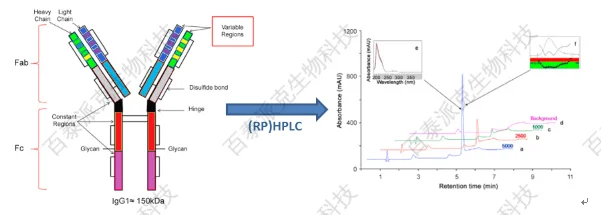
Figure 1
BiotechPack, A Biopharmaceutical Characterization and Multi-Omics Mass Spectrometry (MS) Services Provider
Related Services:
SDS-PAGE Protein Purity Analysis
Protein Purity and Homogeneity Characterization
Peptide Mass Spectrometry Identification
Peptide Biomarker Identification
How to order?




