






Revealing CD Circular Dichroism: A Key Analytical Tool in Biopharmaceutical Research
The research of biopharmaceuticals aims to understand and utilize the properties of biomolecules to develop innovative therapeutic methods. In this regard, the study of protein structures and interactions is crucial. Circular Dichroism (CD) spectroscopy, with its unique advantages, has become an indispensable analytical tool in biopharmaceutical research. This article will explore in detail the role of CD spectroscopy in biopharmaceutical research, revealing its importance in analyzing protein structures and interactions, providing the reader with informative and engaging scientific knowledge.
1. Basic Principles of CD Spectroscopy
CD spectroscopy is a technique used to measure the absorption and scattering of circularly polarized light by substances. When proteins or other biomolecules have chiral structures, they exhibit specific absorption and scattering effects on circularly polarized light. By measuring the differential absorption of circularly polarized light at different wavelengths, CD spectroscopy provides information about molecular structures. Particularly for proteins, CD spectroscopy can reveal secondary structural features such as α-helices and β-sheets.
2. A Key Tool for Protein Structure Analysis
The structure of proteins is crucial for their function and interactions. CD spectroscopy plays an important role in analyzing protein structures. By measuring the CD spectrum of protein samples, we can obtain information about the content and distribution of different secondary structural elements within a protein sample. This helps in understanding the folding state, stability, and structural characteristics of proteins, providing a crucial structural basis for the study of protein functions and biopharmaceutical development.
3. A Key Means for Interaction Studies
The interactions between proteins and other molecules are of great significance in biopharmaceutical research. CD spectroscopy can be used to study the interactions between proteins and ligands, drugs, or other biomolecules. By comparing the CD spectra of proteins in their free state and when bound to other molecules, we can understand the impact of binding on protein structure, revealing interface regions of interaction and binding mechanisms. This provides important information and guidance for drug development and biomolecular interaction studies.
4. Prospects and Progress
CD spectroscopy has broad application prospects in the field of biopharmaceutical research. With continuous technological advancements, CD spectroscopy can now achieve high sensitivity and high-resolution protein structure analysis, and it can even be used to study the structure of macromolecular complexes. Additionally, when combined with other techniques such as mass spectrometry and nuclear magnetic resonance, the application scope of CD spectroscopy can be further expanded, leading to more comprehensive and in-depth biopharmaceutical research.
5. Conclusion
CD spectroscopy serves as a key analytical tool in biopharmaceutical research. By measuring the differential absorption of circularly polarized light by samples, CD spectroscopy can reveal the secondary structural features of proteins and their interactions with other molecules. This provides crucial clues for understanding the structure and function of proteins. With ongoing technological development, the application prospects of CD spectroscopy in biopharmaceutical research are becoming broader. A deeper understanding of the role of CD spectroscopy in biopharmaceutical research will bring more breakthroughs in the development of biopharmaceuticals and life sciences research.
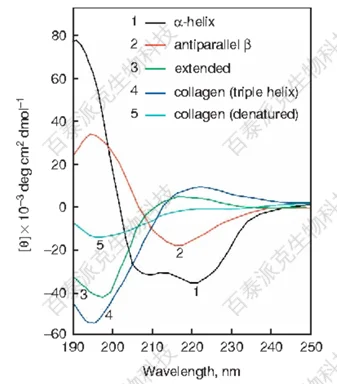
Figure 1
Bio-Tek Pack Biotechnology - Characterization of Bioproducts, High-Quality Multi-Group Biological Mass Spectrometry Services Provider
Related Services:
Protein Circular Dichroism Analysis
Protein Structure Identification
Protein Primary Structure Determination
Mass Spectrometry-Based Sequence Analysis
Protein Disulfide Bond Identification and Quantitative Analysis
How to order?




