






What to explore if the protein does not show peaks during HPLC?
The absence of peaks in protein HPLC is a typical but complex issue involving multiple factors such as mobile phase, column type, sample conditions, and detector settings. It requires strict adherence to experimental principles for step-by-step troubleshooting. Below isa systematic path for investigation and optimizationsuitable for protein/peptide analysis.
I. Problem Classification and Priority Troubleshooting Order
1. Detector Signal Issues (Check First)
(1) Verify whetheran appropriate detection wavelength has been set(commonly 214, 220, or 280 nm);
(2) If the protein lacks aromatic residues (such as Trp, Tyr), absorption at 280 nm is weak, it is recommended to switch to 214–220 nm;
(3) Try runningBSA or standard protein as a controlto determine if the detector is functioning properly;
(4) Check if background noise is excessively high or if there is baseline drift, which may obscure small peaks.
Prioritize resolving whether there truly 'aren't any peaks'or if 'peaks are present but too weak/wrong wavelength/high baseline'.
2. Column Type and Compatibility Issues
Different types of proteins require matching with different columns:
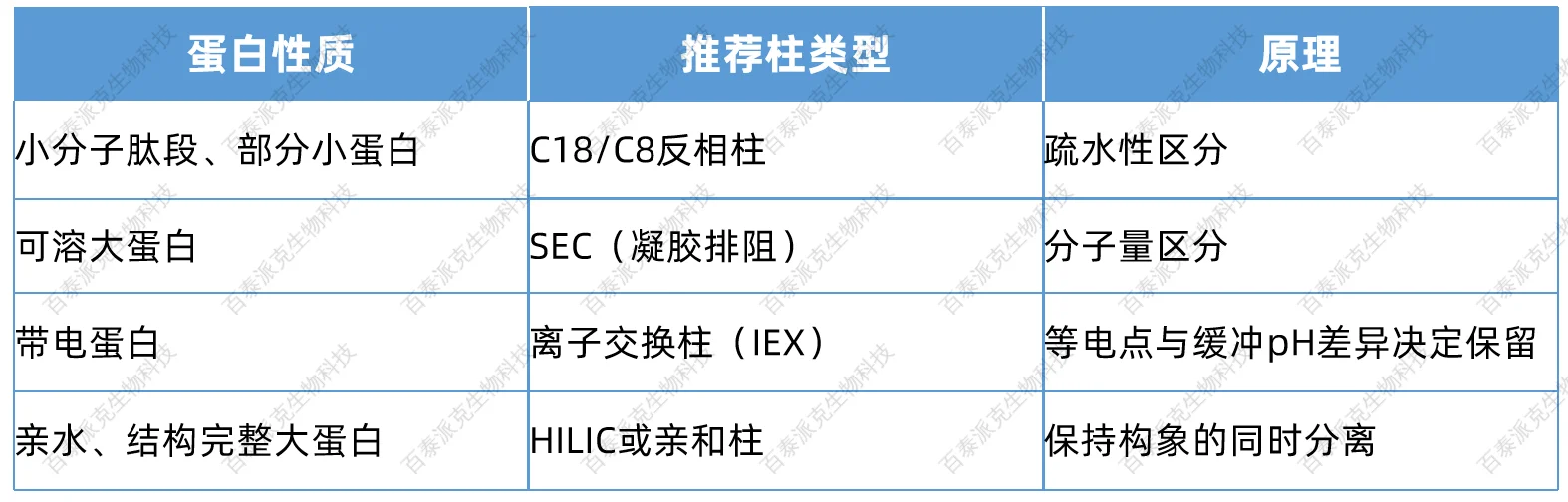
Incorrect column type (e.g., using a reverse-phase column to analyze highly hydrophilic proteins) often results in no adsorption → direct flow-through → no peaks。
3. Has the sample entered the column?
(1) Verify if the sample is dissolved in the initial mobile phase (it should not precipitate or aggregate);
(2) Check if the sample has been filtered with a 0.22 μm filter to avoid column blockage;
(3) Check if the injection volume is too low, it is recommended for initial testinginject at least 20–50 μg of proteinto ensure signal presence.
4. Is the mobile phase appropriate?
The common system for proteins is as follows:
(1) Reverse phase conditions (suitable for peptides and small proteins):
- Solvent A: 0.1% TFA (or FA) in water
- Solvent B: 0.1% TFA in acetonitrile
- Gradient: 5–60% B, 30–60 minutes
(2) Ion exchange conditions:
- Starting buffer: low salt (e.g., 20 mM Tris, pH adjusted according to the protein's IEP)
- Gradient elution buffer: with salt (e.g., Tris + NaCl, up to 1 M)
If the sample pH is close to the protein's isoelectric point, the protein may not carry a charge,making it unable to bind to the ion exchange columnand thus 'no peak appears'.
5. Issues with the protein itself
(1) Has the protein aggregated or denatured? (e.g., due to multiple freeze-thaw cycles, large pH changes);
(2) Consider using denaturing conditions (such as adding 0.1% SDS or 6M Urea before loading onto the column);
(3) If it is a native protein, be cautious to avoid irreversible precipitation caused by high temperatures or strong organic solvents.
II. Recommended Exploration Process
Suggested Initial Troubleshooting Process:
1. Standard Sample Test Run → Verify if the system and column are functioning correctly
2、Wavelength/Sample Injection Volume Adjustment → Optimize detection sensitivity
3、Try running peptide-like proteins with a reversed-phase system (e.g., C18), set a 60-minute gradient
4、For medium to large proteins, switch to SEC or IEX systems
5、Explore step by step: change pH, ionic strength of the mobile phase, and elution method
6、If the sample is suspected to be damaged, prepare a fresh sample for testing
"No peaks for protein on HPLC" is mostly caused bymismatched column type, incorrect wavelength setting, insufficient sample solubility, or too low concentrationRecommendation: check detector settings→sample condition→column selection→mobile phase settings sequentially, and gradually optimize conditions with standard sample test runs.
Biotech Park - Biopharmaceutical Characterization, Quality Mass Spectrometry Detection Services for Multiple Biological Samples
Related Services:
How to order?




