






Circular Dichroism Spectroscopy to Guide the Study of Protein Structure and Function Relationship
Proteins are essential molecules in living organisms, with their structure closely related to function. Understanding the relationship between protein structure and function is crucial for comprehending cellular biological processes, disease mechanisms, and drug development. Over the past few decades, scientists have developed various techniques to study protein structures, among which circular dichroism (CD) spectroscopy is a widely used method. This article will detail the principles and applications of CD spectroscopy and its importance in guiding research on the relationship between protein structure and function.
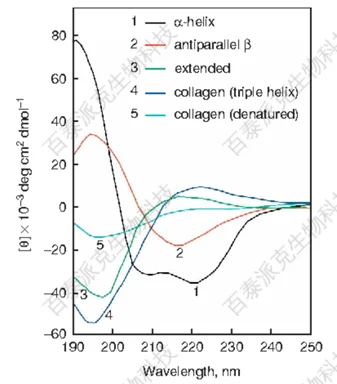
Figure 1
1.Basic Principles of Circular Dichroism Spectroscopy:
Circular dichroism (CD) spectroscopy is a technique used to study the secondary structure of proteins by measuring their absorption and scattering of circularly polarized light. The secondary structure of proteins is determined by hydrogen bonds and other non-covalent interactions between amino acid residues, which lead to specific absorption properties at different wavelengths. CD spectroscopy provides secondary structure information by measuring the differential absorption of left-handed and right-handed circularly polarized light by proteins.
2.Applications of Circular Dichroism Spectroscopy in Protein Structure Research:
2.1 Identification of α-helices and β-sheets:Circular dichroism spectroscopy can distinguish common secondary structures such as α-helices and β-sheets. By analyzing the characteristic peaks and troughs of the absorption curve, the content and spatial distribution of these secondary structures in proteins can be determined.
2.2 Study of Protein Folding States:Circular dichroism spectroscopy can help study the folding states of proteins. Under denaturing conditions, proteins lose their original secondary structure. CD spectroscopy can monitor structural changes during denaturation and refolding processes, revealing the stability and dynamic properties of folding states.
2.3 Conformational Changes in Proteins:Circular dichroism spectroscopy can also detect conformational changes in proteins under different conditions. Factors such as temperature, pH, and solvents can induce structural changes in proteins, and CD spectroscopy can quantitatively analyze these changes, revealing the stability and mechanisms of conformational changes.
3.Research on the Relationship Between Circular Dichroism Spectroscopy and Protein Function:
The structure of proteins is closely related to their function. Circular dichroism spectroscopy can provide information about protein structure, which helps understand protein function. For example, the secondary structure of proteins can influence their interactions with other molecules, affecting functions such as signal transduction, enzyme activity, and ligand binding. Through CD spectroscopy analysis, we can study the relationship between protein structure and function, providing important insights for understanding the biological functions of proteins.
Circular dichroism spectroscopy is an important technique that can provide information about the secondary structure of proteins. Through CD spectroscopy analysis, we can identify types of secondary structures in proteins, study protein folding states and conformational changes, and reveal the relationship between protein structure and function. This technique has broad applications in the field of biopharmaceutical protein research, offering significant guidance and reference for drug design and disease treatment.
Biotech Company--BiologicalProductsCharacterization, multi-group biological mass spectrometry testing high-quality service provider
Related Services:
Protein Circular Dichroism Analysis
Determination of Protein Primary Structure
Protein Secondary Structure Analysis
Detection of Disulfide Bonds/Free Cysteine in Biopharmaceuticals
Identification and Quantitative Analysis of Protein Disulfide Bonds
Protein Identification
Shotgun Proteomics Identification
Hydrogen-Deuterium Exchange Mass Spectrometry (HDX MS)
Characterization of PTMs Based on Top-Down Approach
Determination of Isoelectric Point of Proteins
Molecular Weight Determination
Characterization of Protein Purity and Homogeneity
How to order?




