






Biomolecular Decoding: Advanced Mass Spectrometry Methods for Peptide Structure Identification
Proteins are among the most important molecules in living organisms, playing a crucial role in cellular functions and biological processes. Understanding protein structure is significant for revealing their functions and in drug development. In protein structure research, the identification of peptide structures is a key step.
1. Significance of Peptide Structure Identification
Peptides are short-chain proteins composed of amino acids, and their structure determines their function and mode of interaction. Understanding peptide structure can reveal their biological activity, interaction partners, and disease-related changes. Therefore, peptide structure identification is of great significance for drug development and biological research.
2. Traditional Methods for Peptide Structure Identification
In the past, peptide structure identification mainly relied on X-ray crystallography and nuclear magnetic resonance (NMR) techniques. X-ray crystallography determines structure by measuring the diffraction patterns of peptide crystals but requires high-quality crystal samples. NMR techniques infer structure by measuring the nuclear magnetic resonance signals of peptide molecules, but this method is limited in its application to large peptide molecules.
3. Application of Advanced Mass Spectrometry Methods
In recent years, with the development of mass spectrometry, advanced mass spectrometry methods have been widely applied in peptide structure identification. The following are some common advanced mass spectrometry methods:
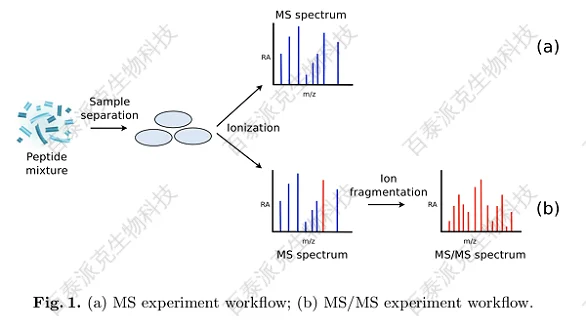
Figure 1
3.1 Mass Spectrometry Imaging
Mass spectrometry imaging is a method that combines mass spectrometry with histology, allowing the determination of the spatial distribution of peptides within tissue samples. By slicing the sample and analyzing it on a mass spectrometer, distribution images of peptides can be obtained, revealing their localization and function in tissues.
3.2 Mass Spectrometry Coupling Techniques
Mass spectrometry coupling techniques combine mass spectrometry with other analytical techniques (such as liquid chromatography, gas chromatography, etc.) to improve the accuracy and sensitivity of peptide structure identification. For example, liquid chromatography-mass spectrometry (LC-MS) can separate peptide mixtures and analyze them on a mass spectrometer to identify and quantify the structures of various peptides.
3.3 Mass Spectrometry Quantification Techniques
Mass spectrometry quantification techniques can be used to determine the relative or absolute content of peptides, thereby revealing changes in biological processes. For instance, quantitative mass spectrometry can infer peptide concentrations by measuring peak intensities to study expression levels and regulatory mechanisms of peptides under different conditions.
4. Future Directions
With continuous technological advancements, methods for peptide structure identification are also evolving. Future developments can be expected in the following areas:
4.1 Development of New Mass Spectrometers
The development of new mass spectrometers will further enhance the accuracy and sensitivity of peptide structure identification. For example, the application of high-resolution mass spectrometers and ion tracking mass spectrometers will help solve the challenges of identifying large peptide molecules.
4.2 Improvement of Data Analysis Algorithms
Improvements in data analysis algorithms will enhance the efficiency and reliability of peptide structure identification. By developing new algorithms and software tools, mass spectrometry data can be more accurately interpreted to infer peptide structure and function.
4.3 Establishment of Peptide Structure Databases
Establishing peptide structure databases will facilitate rapid and accurate peptide structure identification. By integrating known peptide structure information and analyzing mass spectrometry data results, a comprehensive peptide structure database can be created, providing important references for peptide research.
Conclusion
Peptide structure identification is a crucial step in protein research, significant for revealing their functions and in drug development. The application of advanced mass spectrometry methods provides new pathways and tools for peptide structure identification. Future advancements will further promote the progress of peptide structure identification technologies, providing more possibilities for biological research and drug development.
BiotechPack, A Biopharmaceutical Characterization and Multi-Omics Mass Spectrometry (MS) Services Provider
Related Services:
Peptide Mass Spectrometry Identification
Molecular Weight Determination
Peptide Biomarker Identification
How to order?




