






Common Questions about Untargeted Quantitative Proteomics SILAC
SILAC (Stable Isotope Labeling by Amino acids in Cell culture) in non-targeted quantitative proteomics is a powerful mass spectrometry method for quantitatively comparing protein expression in different cell states. The SILAC method relies on cells incorporating amino acids labeled with heavy nitrogen or carbon isotopes into newly synthesized proteins, allowing for quantitative protein analysis. Although this technique is very useful in proteomics research, researchers may encounter the following common issues during its application:
1. Sample Preparation and Culture Conditions:
How to correctly select and prepare media containing stable isotope-labeled amino acids, and how to ensure that cell growth conditions are not affected?
- The key to correctly selecting media containing stable isotope-labeled amino acids is to determine the type (e.g., ^13C, ^15N) and concentration of isotope labeling required.
- The key to ensuring that cell growth conditions are not affected is to monitor the growth rate and morphology of the cells, ensuring they are similar to conditions without labeling.
2. Efficiency and Consistency of Isotope Labeling:
How to ensure that cells fully and consistently utilize labeled amino acids? This is crucial for the accuracy of subsequent analyses.
- Methods to ensure cells fully utilize labeled amino acids include long-term culture (usually several cell cycles) and using mass spectrometry to monitor the integrity and consistency of labeling.
3. Mass Spectrometry Analysis:
What challenges might be encountered in acquiring, processing, and interpreting mass spectrometry data? How to ensure the accuracy and reproducibility of the data?
- Challenges in mass spectrometry data include sample complexity, signal interference, and the sensitivity and resolution of the instrument.
- Ensuring data accuracy and reproducibility requires optimizing sample preparation steps, using appropriate mass spectrometry methods, and conducting thorough data quality control.
4. Data Processing and Bioinformatics Analysis:
What software and tools are suitable for processing SILAC data? How to handle large amounts of mass spectrometry data to obtain meaningful biological information?
- Software and tools suitable for processing SILAC data include MaxQuant and Proteome Discoverer.
- Data processing needs to focus on the accuracy of protein quantification, isotope labeling efficiency, and data normalization methods.
5. Application Scope and Limitations:
For what types of samples is the SILAC technique suitable? What are its limitations, such as application issues in non-proliferating cells or specific types of cells?
- The SILAC technique is suitable for most proliferating cells, but there may be challenges in non-proliferating cells or certain specific types of cells, such as low labeling efficiency or inability to achieve labeling.
- Choosing the appropriate cell type and experimental design is key.
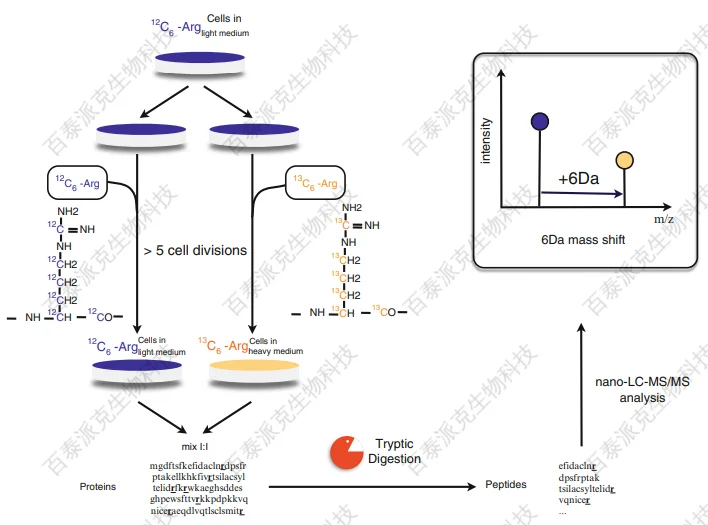
Figure 1
BiotechPack, A Biopharmaceutical Characterization and Multi-Omics Mass Spectrometry (MS) Services Provider
Related Services:
Label-based protein quantification technologies - iTRAQ, TMT, SILAC
Quantitative proteome analysis
Label-free quantitative proteome analysis
TMT/iTRAQ/MultiNotch quantitative proteomics analysis
SILAC/Dimethyl labeling-based quantitative proteome analysis
SWATH quantitative proteomics service
2D-DIGE quantitative proteomics
MRM/PRM quantitative proteomics analysis
Absolute quantification analysis (AQUA)
How to order?




