






Label-free vs. Labeling: Comparative Analysis of Label-free and TMT
In the field of biopharmaceuticals, protein quantification is a crucial task. In protein quantification, label-free and labeled techniques are two commonly used methods. Among them, label-free and TMT are widely used techniques. This article will provide a detailed comparative analysis of these two techniques.
1. Label-free Technique
The label-free technique is a method for protein quantification that does not require the addition of labels. The advantages of this method are simplicity, speed, high sensitivity, and wide applicability. The principle of the label-free technique is to quantify proteins by comparing the peak area or peak height of proteins in samples. This method requires the use of high-resolution mass spectrometers, such as Q-TOF or Orbitrap.
The advantage of the label-free technique is that it can simultaneously detect multiple samples without requiring additional labels, thus reducing costs. Furthermore, the label-free technique can detect unknown proteins because it does not require specific labels.
However, the label-free technique also has some drawbacks. Firstly, it requires high-resolution mass spectrometers, which increases equipment costs. Secondly, the label-free technique has certain limitations regarding sample complexity and dynamic range. Lastly, the accuracy and precision of the label-free technique are influenced by many factors, such as sample preparation, mass spectrometer performance, and data processing.
2. TMT Technique
TMT (Tandem Mass Tag) is a labeling technique that uses isotopic labels to tag proteins. The advantage of this method is that it can simultaneously detect multiple samples, and the labels can increase sensitivity and specificity of protein detection. The principle of TMT is to add different isotopic labels to different samples and then mix these samples for mass spectrometry analysis.
The advantages of the TMT technique are the ability to simultaneously detect multiple samples, and the labels can increase the sensitivity and specificity of protein detection. Additionally, TMT can detect unknown proteins because it does not require specific labels.
However, the TMT technique also has some disadvantages. Firstly, it requires additional labels, thus increasing costs. Secondly, the TMT technique has certain limitations regarding sample complexity and dynamic range. Finally, the accuracy and precision of the TMT technique are affected by many factors, such as label stability, sample preparation, mass spectrometer performance, and data processing.
3. Label-free vs. TMT
Both label-free and TMT techniques have their advantages and disadvantages. When choosing which technique to use, it is important to consider the purpose of the experiment, the complexity and dynamic range of the samples, the availability of equipment, and costs.
If simultaneous detection of multiple samples is required, the TMT technique is a better choice. TMT can use multiple isotopic labels to tag different samples and then mix these samples for mass spectrometry analysis. This method can greatly enhance sample throughput and detection sensitivity.
If only a few samples or unknown proteins need to be detected, the label-free technique might be more suitable. The label-free technique does not require specific labels, making it suitable for the detection of unknown proteins. Additionally, the label-free technique is generally less expensive as it does not require additional labels.
The label-free technique uses mass spectrometers to directly analyze proteins in samples. This method can provide accurate and precise protein quantification results. At the same time, the sample preparation steps for the label-free technique are relatively simple, as no additional label processing is required.
However, the label-free technique also has limitations. Firstly, the label-free technique has certain limitations regarding sample complexity and dynamic range. More complex samples may cause overlap in mass spectrometry signals, reducing quantification accuracy. Secondly, label-free techniques may require higher mass spectrometer resolution and sensitivity to ensure accurate protein quantification.
In conclusion, both label-free and TMT techniques have their respective advantages and disadvantages, and the choice should be based on comprehensive consideration of experimental requirements and conditions. For studies requiring simultaneous detection of multiple samples and high detection sensitivity, the TMT technique may be more suitable. For the detection of small numbers of samples or unknown proteins, the label-free technique might be more appropriate. Regardless of the chosen technique, attention should be paid to the optimization of sample preparation and the performance of mass spectrometers to obtain accurate and reliable results.
4. Conclusion
In the field of biopharmaceuticals, protein quantification is very important. Label-free and TMT techniques are commonly used for protein quantification. These two techniques have their own advantages and disadvantages. The choice of the appropriate technique depends on the experimental needs and conditions. For studies requiring simultaneous detection of multiple samples and high detection sensitivity, the TMT technique is a better choice. For the detection of small numbers of samples or unknown proteins, the label-free technique may be more suitable. When conducting protein quantification experiments, it is essential to optimize sample preparation and ensure mass spectrometer performance to obtain accurate and reliable results.
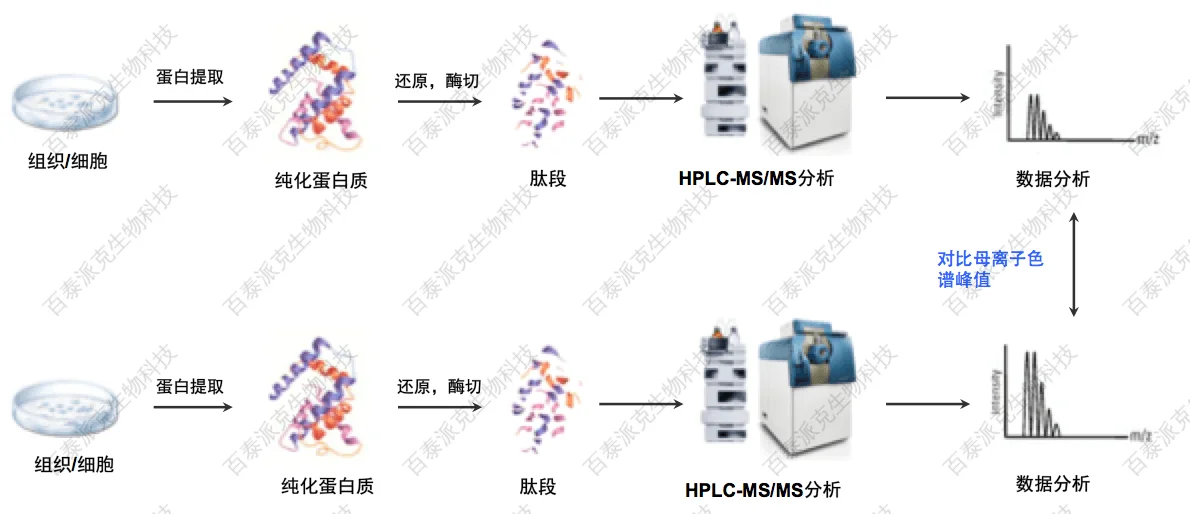
Figure 1
BiotechPack, A Biopharmaceutical Characterization and Multi-Omics Mass Spectrometry (MS) Services Provider
Related Services:
Label-Free Based Quantitative Proteomics Analysis
Quantitative Proteomics Analysis
Label-Based Protein Quantification Techniques - iTRAQ, TMT, SILAC
TMT/iTRAQ/MultiNotch Quantitative Proteomics Analysis
SILAC/Dimethyl Labeling Based Quantitative Proteomics Analysis
SWATH Quantitative Proteomics Services
2D-DIGE Quantitative Proteomics
MRM/PRM Quantitative Proteomics Analysis
Absolute Quantification Analysis (AQUA)
Post-Translational Modification Proteomics Analysis
How to order?




