






The Role of Mass Spectrometry in the Analysis of Protein Post-Translational Modifications
Proteins are key molecules that perform various biological functions within living organisms. However, the function of a protein is not solely determined by its amino acid sequence; it is also influenced by post-translational modifications (PTMs). PTMs refer to the structural or chemical changes that occur to proteins after the translation process is complete, through chemical reactions. These modifications can affect the structure, stability, activity, and interaction capabilities of proteins. Mass spectrometry is a powerful tool that provides an effective means for studying post-translational modifications of proteins.
1. Significance of Protein Post-Translational Modifications
Protein post-translational modifications play an important role in maintaining normal biological functions and regulating various physiological processes. Common PTMs include phosphorylation, methylation, acetylation, and glycosylation. These modifications can alter the charge, spatial conformation, stability, and interaction capability of proteins, thereby regulating processes such as protein activity, localization, and degradation.
2. Basic Principles of Mass Spectrometry
Mass spectrometry is an analytical method based on ion mass and relative abundance, suitable for identifying and quantifying protein post-translational modifications. Its basic principle involves converting protein samples into gaseous ions, which are then separated, measured, and detected by mass spectrometers. Key steps in protein mass spectrometry include sample preparation, mass spectrometer setup, and data analysis.
3. Applications of Mass Spectrometry in Modification Analysis
3.1 Identification of Modification Types: Mass spectrometry can accurately identify various types of modifications present in proteins. Through mass spectrometric analysis, the position, type, and abundance of modifications can be determined, helping to elucidate protein function and regulatory mechanisms.
3.2 Quantification of Modification Abundance: Mass spectrometry can not only identify the presence of modifications but also quantify their abundance. Through quantitative mass spectrometric analysis, the dynamic changes of modifications under different conditions can be understood, revealing the relationship between modifications and protein function.
3.3 Discovery of New Modifications: The high sensitivity and high resolution of mass spectrometry make it capable of discovering new modifications. By analyzing mass spectra of unknown modifications, new types of modifications can be discovered, expanding our understanding of protein modifications.
4. Applications of Mass Spectrometry in Biopharmaceutical Development
4.1 Drug Development and Quality Control: Mass spectrometry can be used for the post-translational modification analysis of biopharmaceuticals, ensuring the quality and consistency of the drugs.
4.2 Immunogenicity Assessment of Biopharmaceuticals: Mass spectrometry can be used to identify and quantify immunogenic modifications in drugs, providing important data for immunogenicity assessments of pharmaceuticals.
4.3 Stability Studies of Protein Drugs: Mass spectrometry can be used to study how modification changes affect the stability and activity of protein drugs, thereby optimizing their stability and storage conditions.
Mass spectrometry plays an important role in the analysis of protein post-translational modifications. Through mass spectrometry, we can identify, quantify, and study various protein post-translational modifications to gain deeper insights into protein functions and regulatory mechanisms. In biopharmaceutical development, mass spectrometry can be used for drug quality control, immunogenicity assessment, and stability studies, providing key support for the development and optimization of biopharmaceuticals. As mass spectrometry continues to develop and improve, we believe it will continue to play an important role in the field of protein post-translational modification analysis and promote research and development in the biopharmaceutical field.
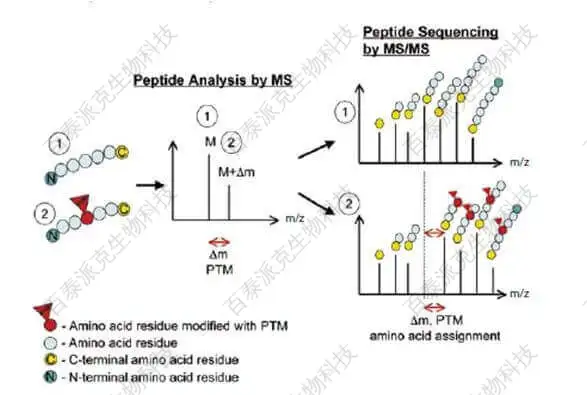
Figure 1
BaiTaiPike BioTechnology - Characterization of Bioproducts, A Quality Service Provider of Multi-Omics Mass Spectrometry
Related Services:
Post-Translational Modification Proteomics Analysis
Phosphorylation Quantitative Proteomics Study
Acetylation Quantitative Proteomics Study
Ubiquitination Quantitative Proteomics Study
Glycosylation Quantitative Proteomics Study
Protein Disulfide Bond Identification and Quantitative Analysis
Histone Post-Translational Modification Analysis
Multi-Pathway Phosphorylation Proteomics
Methylation Quantitative Proteomics Study
Acylation Quantitative Proteomics Study
How to order?




